Inviting contributions to a special issue on animal behaviour

Kristal Cain (University of Auckland), Stephanie Godfrey (University of Otago) and myself are guest editing an upcoming special issue on animal behaviour in the New Zealand Journal of Zoology. If you’re interested in contributing please get in touch with us. Details from the Royal Society webpage pasted below and you can visit here for more information.
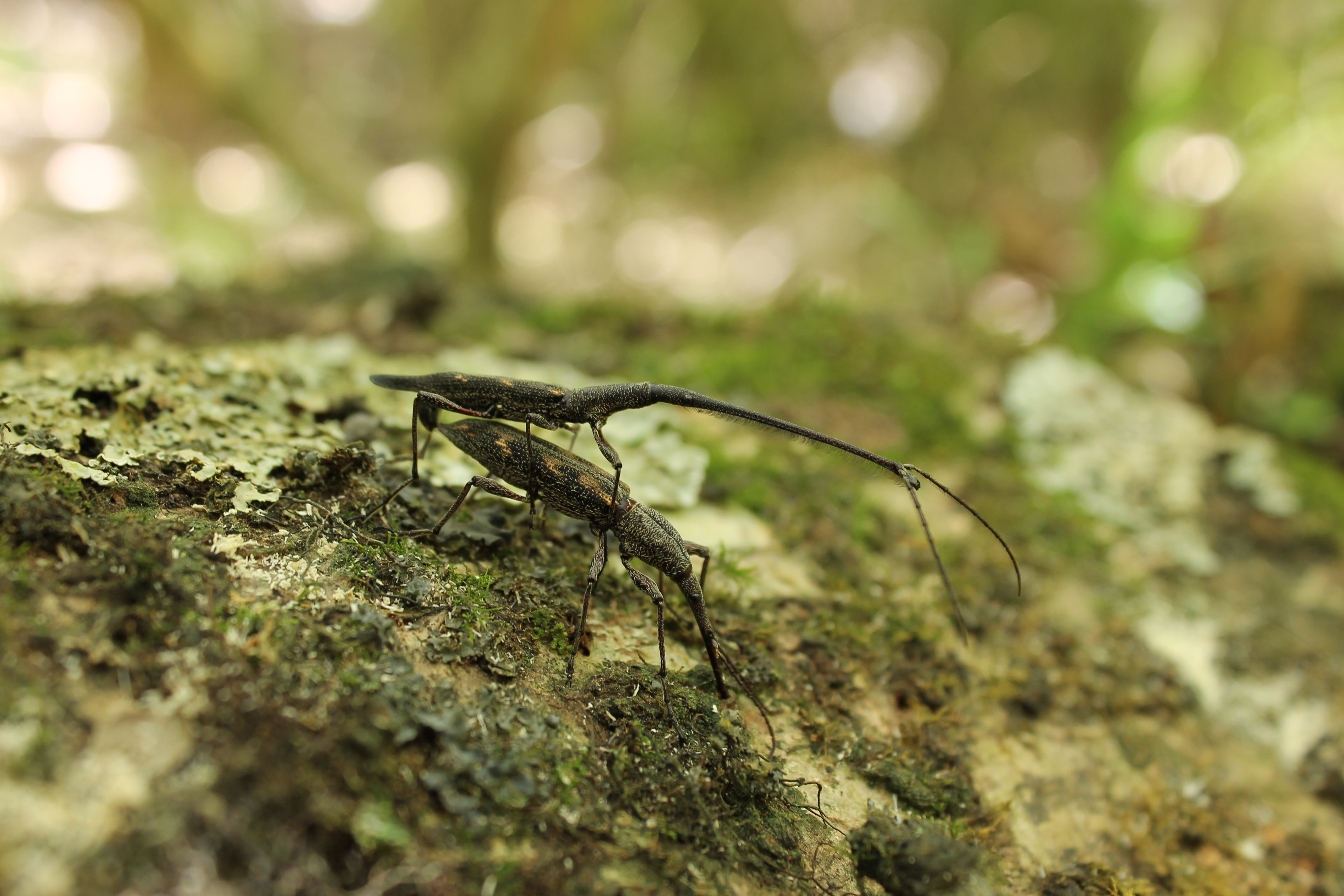
This special issue of the New Zealand Journal of Zoology invites submissions with a focus on the remarkable diversity of animal behaviour in Aotearoa New Zealand and Australasia more broadly.

Behaviour is one of the most fascinating aspects of biology, shaped by interactions between morphology, physiology, cognition, and ecology. Variation in behaviour can have profound consequences for survival and reproduction. Consequently, behaviour is a lynchpin for whether or not animals adapt to the rapidly changing planet and understanding behaviour is central to predicting how populations and ecosystems have and will change. Aotearoa New Zealand and Australasia have some incredibly unique and understudied animals, and this region also plays host to a number of recent arrivals that have adjusted their behaviour to live here. This issue is open to research on them all.

We invite submissions that address the vast variety of animal behaviour research in Aotearoa New Zealand, Australia and the rest of Oceania, the Pacific Basin, South America and Antarctica. This special issue takes a broad view of animal behaviour encompassing empirical, theoretical and comparative approaches. We welcome submissions on the role of ecology and evolutionary history in explaining the occurrence, diversity and adaptive significance of behaviours, and the use of comparative approaches to explore the evolutionary and ecological drivers of behavioural diversity. Submissions concerning the place of animal behaviour in te ao Māori (Māori worldview) or other indigenous perspectives are strongly encouraged. Topics might include, but are not limited to: social and mating behaviour, foraging and predator/prey interactions, reproductive and parental behaviour, dispersal and migration.

Submission information

Please email a preliminary title, list of potential authors and a short descriptive paragraph outlining the scope of your proposed manuscript by 11 Whiringa-ā-rangi November 2022 to the guest editors Dr Kristal Cain (Auckland; k.cain@auckland.ac.nz), Dr Christina Painting (Waikato; chrissie.painting@waikato.ac.nz) and Dr Stephanie Godfrey (Otago; stephanie.godfrey@otago.ac.nz). The guest editors will make a decision on which manuscripts to invite for the special issue and authors will be notified by 25 Whiringa-ā-rangi November 2022.

Note that an invitation to submit does not guarantee acceptance for publication, which will depend on the outcome of the usual peer-review process and authors meeting critical time schedules.

The anticipated manuscript submission deadline is 28 Hui-tanguru February 2023, with the aim of getting the special issue formally published by late 2023. Individual articles will be published online with a DOI before appearing in the compiled special issue.

Simon’s recent adventures in Europe – a travel story!

Blog by PhD candidate Simon Connolly

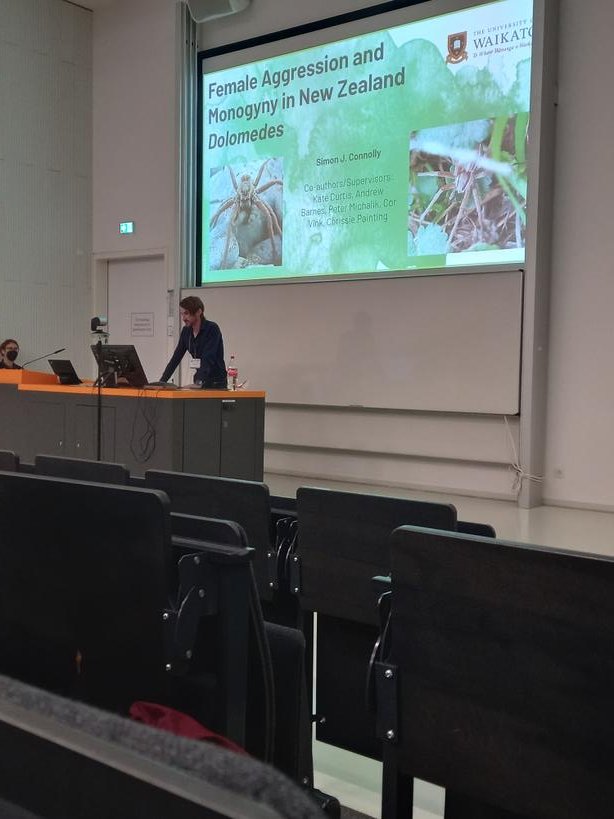
People often ask me why I study spiders. Almost as often, they ask me why I study spider sex. These are fair enough questions, these things are strange and often absurd to the casual observer. My answers to these questions vary, though now I suppose I can answer them with “To see the world!”, as that’s exactly what I just did.

I recently traveled to Europe to present my research at the 33rd European Congress of Arachnology. My travels took me from the Bundestag in Berlin, to the nightlife of Helsinki, and along the way, I found a few reminders of why I study spiders.

Enjoying the sites of Greifswald

This year, the Congress was held in Greifswald, Germany. My travel involved 3 flights, a three hour train ride, and catching a taxi in the dead of night…with my very poor German language skills. Along the way, I was acutely aware of the microscopic elephant in the room, but I managed to avoid a COVID-19 infection through my caution…and sheer good luck.

Greifswald is simultaneously a sleepy German town…and a centre for cutting edge spider research in Europe. It was here that I met with experts from all over the world, all of whom share my passion for the weird and wonderful ways of arachnids. I had the pleasure of benefitting from their expertise…and the somewhat nerve-wracking experience of them benefitting from mine! Over the course of the conference, I heard about: the venom potency of different spider taxa, a mysterious scorpion that lives only in ant nests, the finer aspects of a male spider’s courtship drumbeat, and the use of liquid nitrogen to capture copulating spiders! All great reminders of why spiders and arachnids are so fascinating to study.


I also spent time learning micro-CT segmentation techniques from Peter Michalik and Dante Poy. These techniques will serve me well in my PhD going forward, and in the rest of my scientific career.

Evidence that Simon didn’t just look at pretty buildings & eat strange snacks

Both the congress and learning these techniques were mentally invigorating experiences. To speak with experts in my field, whose work I have cited and read more times than I can count, and seeing their passion for their work, is a reminder of why I study spiders. Spiders are cool, and the humans that study spiders are some of coolest people in the world.

A 3D reconstruction of a spider palp with the embolus highlighted in green

Alone, and with these cool people I explored the tiny town of Greifswald, and its surrounds. I learnt about the Baltic and the DDR; ate Gherkin flavoured Haribo, and other local delicacies; and absorbed the sights, sounds and smells of another culture (to put it in a horribly cliched way).

After my work in Europe was done, I had some time for some personal travel. I used the opportunity to visit a friend of mine in Finland. Here is where I found another reminder of why I study spiders…in the most curious of places.

In amongst the bustling streets of Helsinki, you will find Luonnontieteellinen museo (The Finnish Museum of Natural History). If you ascend the stone staircase to the top, you will find a small, unassuming glass case. Inside this glass case is a taxidermied specimen of a newborn calf. Viewed from the side, as you approach it, this specimen in unremarkable. As you move to the front however, you can see that this calf had two separate and functional heads.

I think this calf means different things to different people. To some it is a mere curiosity, something to glance at on the way to a more important exhibit. To others, it is a broken and twisted creature. To me though, it is a reminder of not only the value and transience of life, but of our responsibility to that life as both scientists and human beings. And that there is beauty in the strange, the absurd and the unique…just like the weirdness of spiders. I think poet Laura Gilpin agrees with me…

MSc student Erin Steed presents her research at the New Zealand Bee Research Symposium

I (Erin) had the privilege of attending the New Zealand Bee Research Symposium and Apiculture New Zealand (APINZ) conference in Christchurch earlier this year. The Bee Research Symposium allows scientists and students from across the country to get together and share their research, giving their insight into where we are headed in the world of beekeeping, honey, mite management, and pollination. The research symposium, along with APINZ conference, create a space for science and industry to mix, ideas to be shared, and for all things honey bees to be celebrated!

I had the opportunity to present my work on the role of drone honey bees in varroa mite dispersal. This included varroa preference for different honey bee castes, and the correlation between varroa captured on drones at drone congregation areas and varroa captured from bees in a colony. Presenting my research in front of other scientists was a great experience, and I got some helpful feedback and comments.

Hearing about the work that other researchers are working on was really exciting too. A particular highlight was hearing from Dr Sammy Ramsey about his fascinating work on the varroa mite and the tropilaelaps mite. Getting to hear from and interact with other people with a passion for honey bees and science was really inspiring, and I feel very lucky to be working in such an exciting field alongside other enthusiastic scientists. 

Erin Steed is a MSc student at the University of Waikato working on the role of drone honey bees in varroa mite dispersal. She’s supervised by Chrissie Painting & Ashley Mortensen (Plant & Food Research).

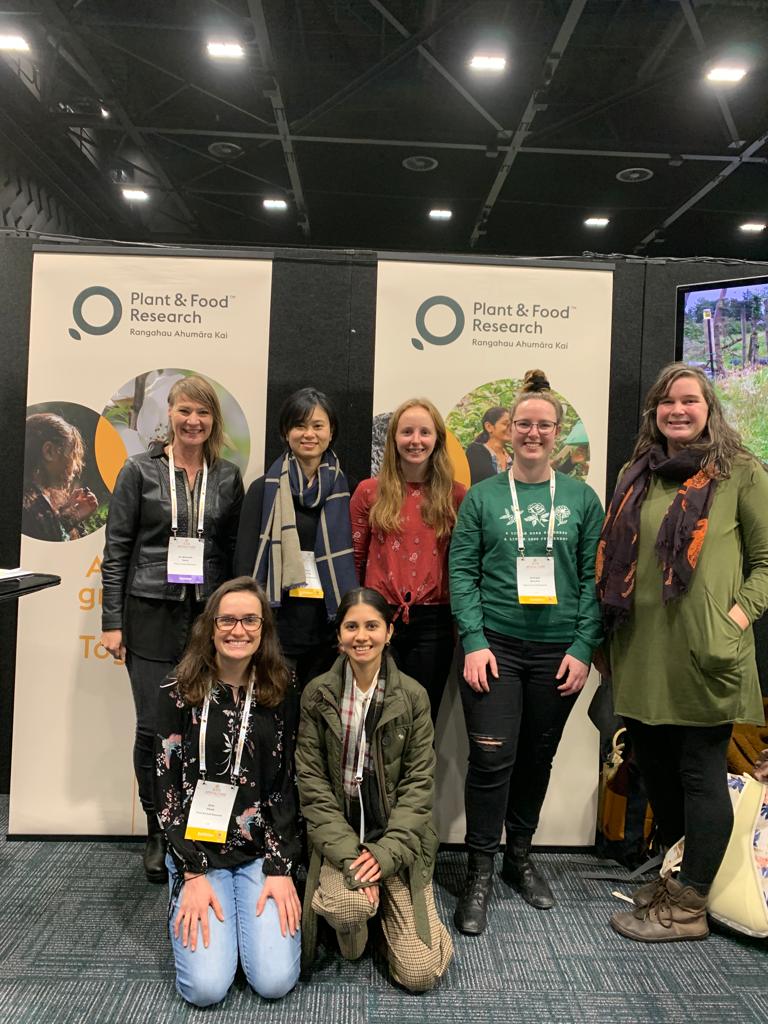
Erin Steed (bottom left) at the APINZ conference with other bee researchers from Plant & Food Research New Zealand