Over the summer, Goldie joined the Invertebrate Behavioural Ecology lab as a summer scholarship student, where she worked on a project focused on insect cuticular hydrocarbons (CHCs) alongside PhD student Lucy. Research on CHCs is just beginning in our lab, following Chrissie being awarded a Mana Tūānuku Research Leader Fellowship in 2025. Cuticular hydrocarbons act like waxy blankets coating the bodies of insects, where they prevent these little critters from drying out in hot conditions. What makes them even more interesting is that they also double as chemical messages, helping insects to work out whether the individual they’ve bumped into is a potential mate, a rival to compete with, or a nest mate they can safely ignore.
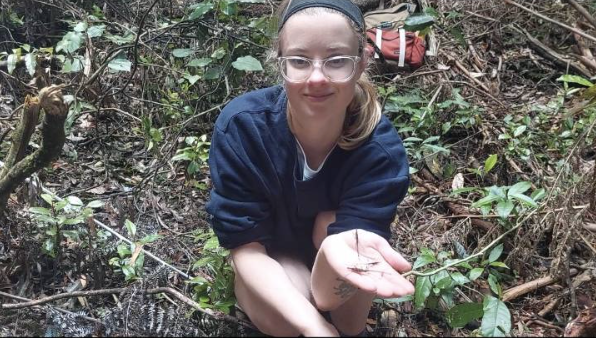
Goldie at Maungatautari with a handful of pepeke nguturoa
As part of this work, Goldie contributed as a second reviewer to a systematic review that aims to identify broad trends in the cuticular hydrocarbon literature, a process that involved reading and screening several thousand abstracts of published papers. Goldie reports that this experience provided valuable insights in the how to do a systematic review, from assessing relevance and methodological quality to synthesising findings across studies.
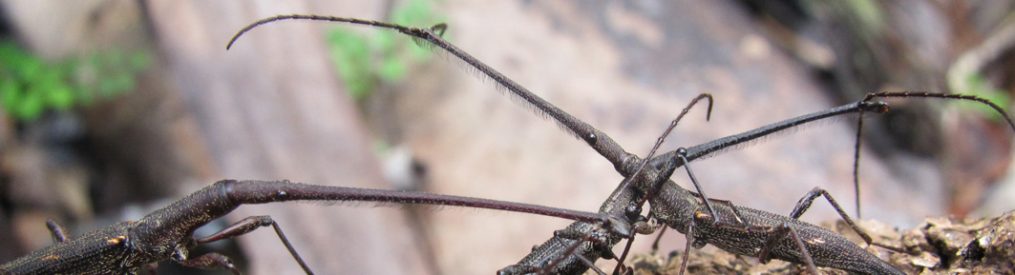
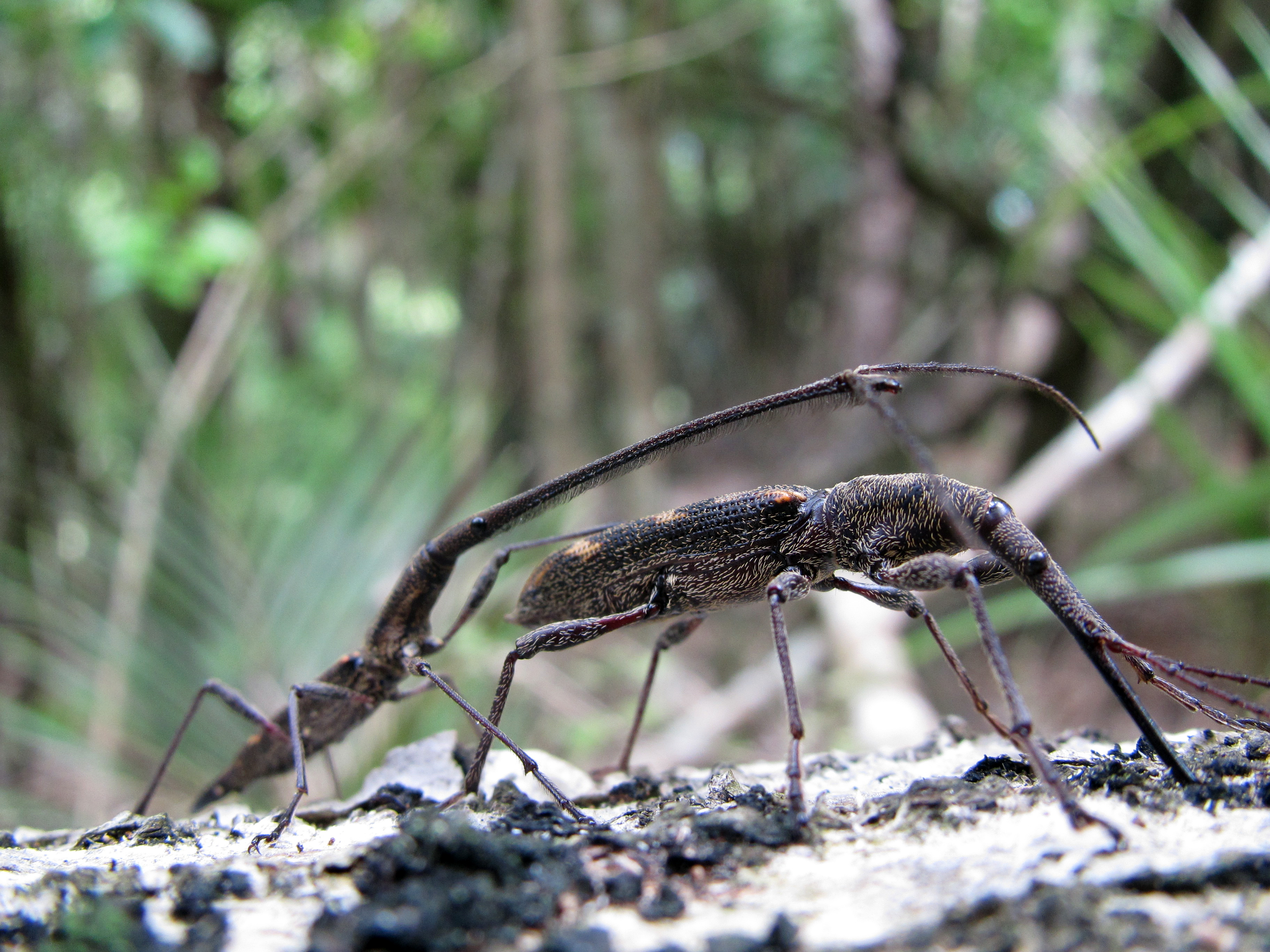
While this work required a LOT of sitting at a computer, Goldie was able to get away from her desk from time to time. She took on responsibility for maintaining our lab cricket colony, learning first-hand about the challenges of raising insects – and finding out just how cannibalistic they are! She also spent time in the field collecting pepeke nguturoa/New Zealand giraffe weevils, which are going to be used by Lucy for analysis of their CHCs. We aim to describe the CHCs of male and female pepeke nguturoa and see how different these chemical coatings are between the sexes and among adults of very different body sizes. Pepeke nguturoa are typically found in native bush habitats during summer, often on fallen logs. Out at Sanctuary Mountain Maungatautari, Goldie learned to locate them by identifying tell-tale signs of larval activity, such as fine sawdust produced as larvae tunnel through wood.
Up close on a pair of pepeke nguturoa
While Goldie’s summer in the Invertebrate Behavioural Ecology lab is about to end, we’ll still get to see her around as she begins her Masters research – even if it is on plants instead of insects!
Rekohu | Wharekauri | the Chatham Islands: a group of islands about 800 kilometres east of New Zealand. The most south-eastern island of this archipelago is called Hokorereoro | Rangatira | South East, uninhabited by humans, but populated by lots of wildlife!
Not only is Hokorereoro | Rangatira a beautiful offshore island and very special place, but it is also the home to a very range-restricted fishing spider: Dolomedes schauinslandi. While a couple of Dolomedes species have been studied in regard to their behavioural ecology, there is not much known on the biology of D. schauinslandi (also called the Rangatira spider). That’s why I am here now: I am spending this summer season with the spiders on Hokorereoro | Rangatira studying their ecology, mating behaviour and life history!
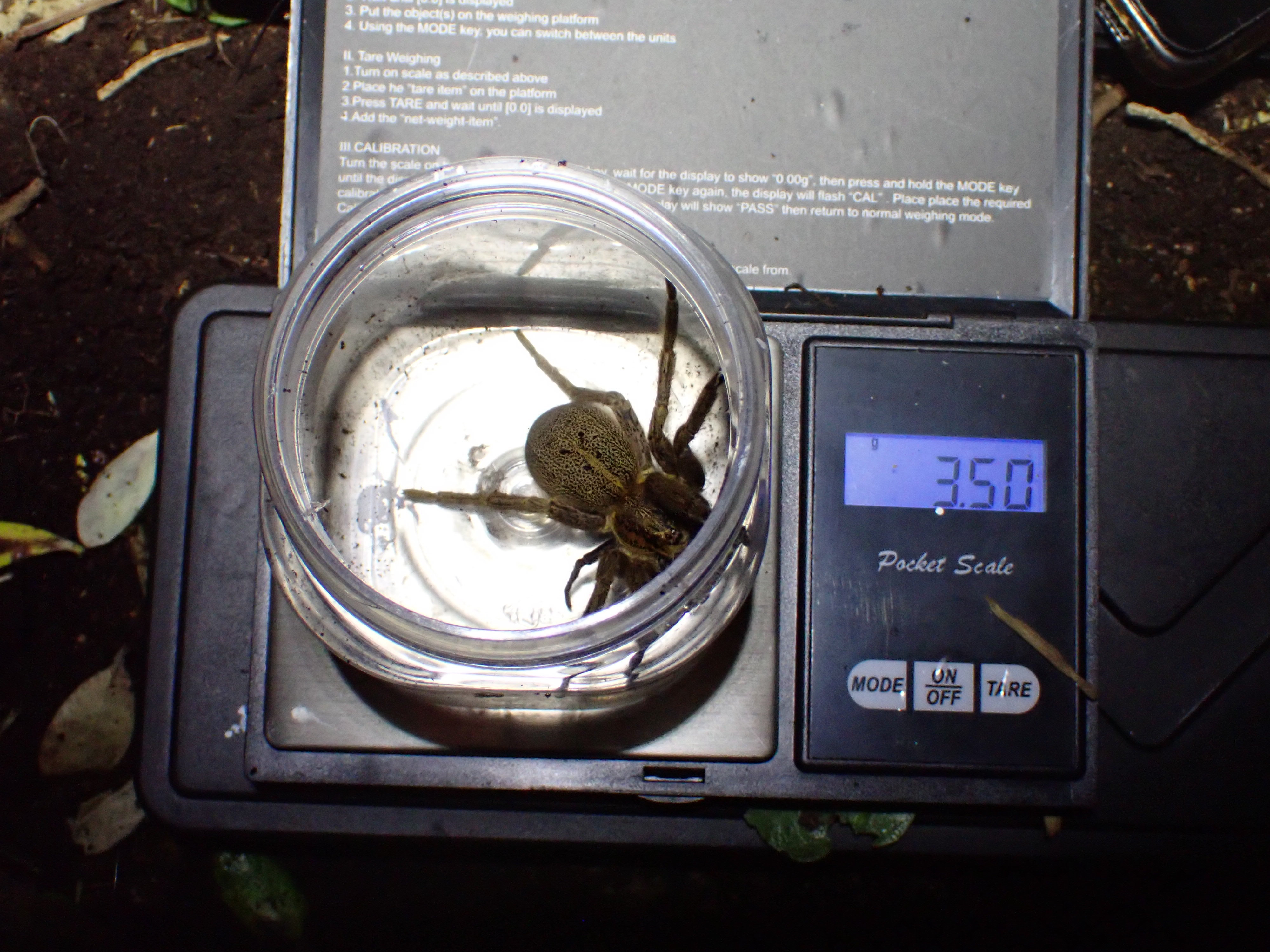
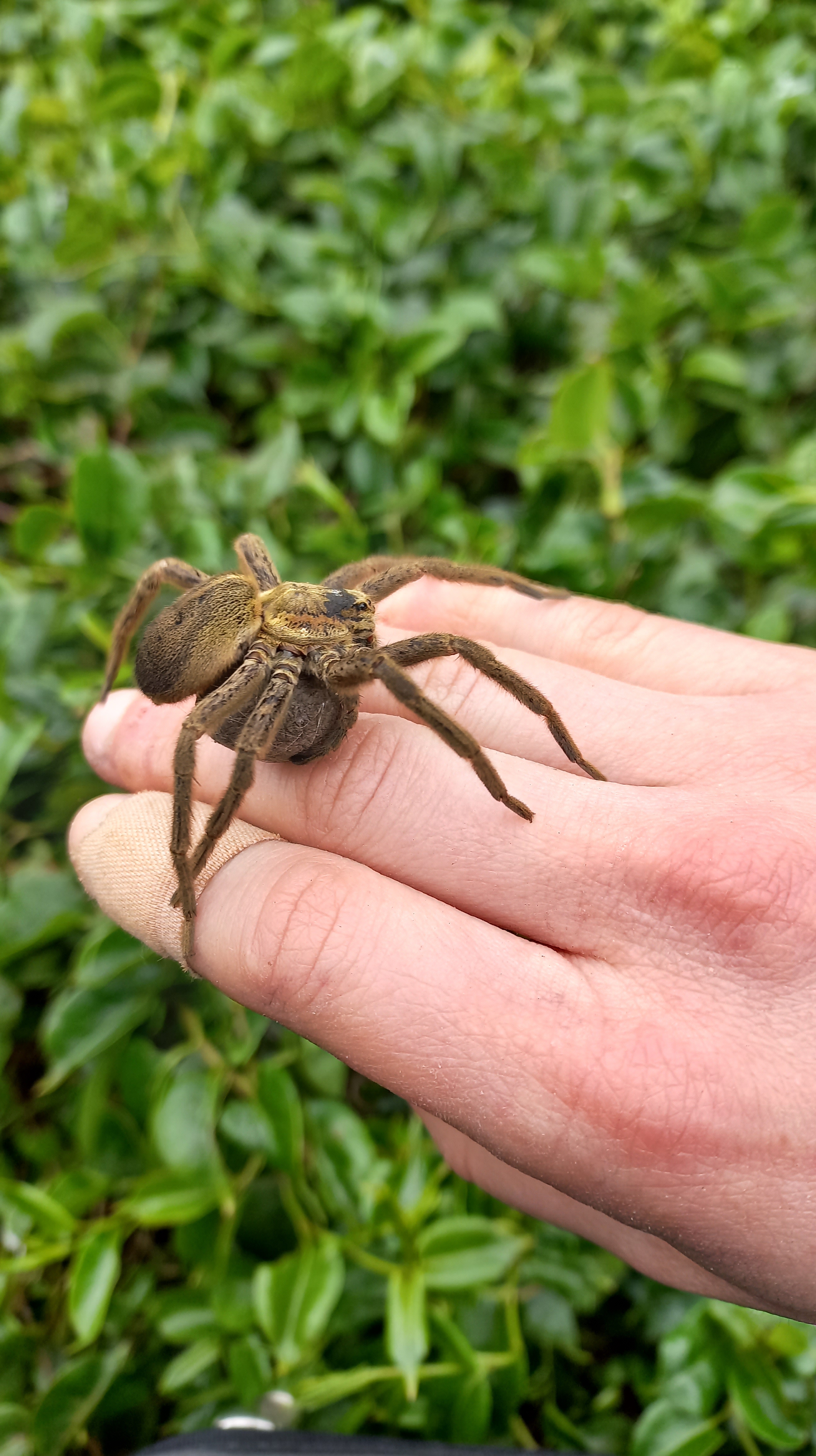
A female Rangatira spider getting weighedA male Rangatira spider with little paint marks to ID him during mark/recapture observations
While fishing spiders are usually known for their astonishing ability to walk and hunt on the water surface of ponds and streams, D. schauinslandi (aka the Rangatira spider) lives on an island with no freshwater bodies and therefore evolved to live and hunt in the forest, mainly on large, old trees. It is incredible how those relatively large spiders can squeeze into the most unrecognizable holes and slits in old wood during the day, just to come out at night and go for a hunt or look for a mate.
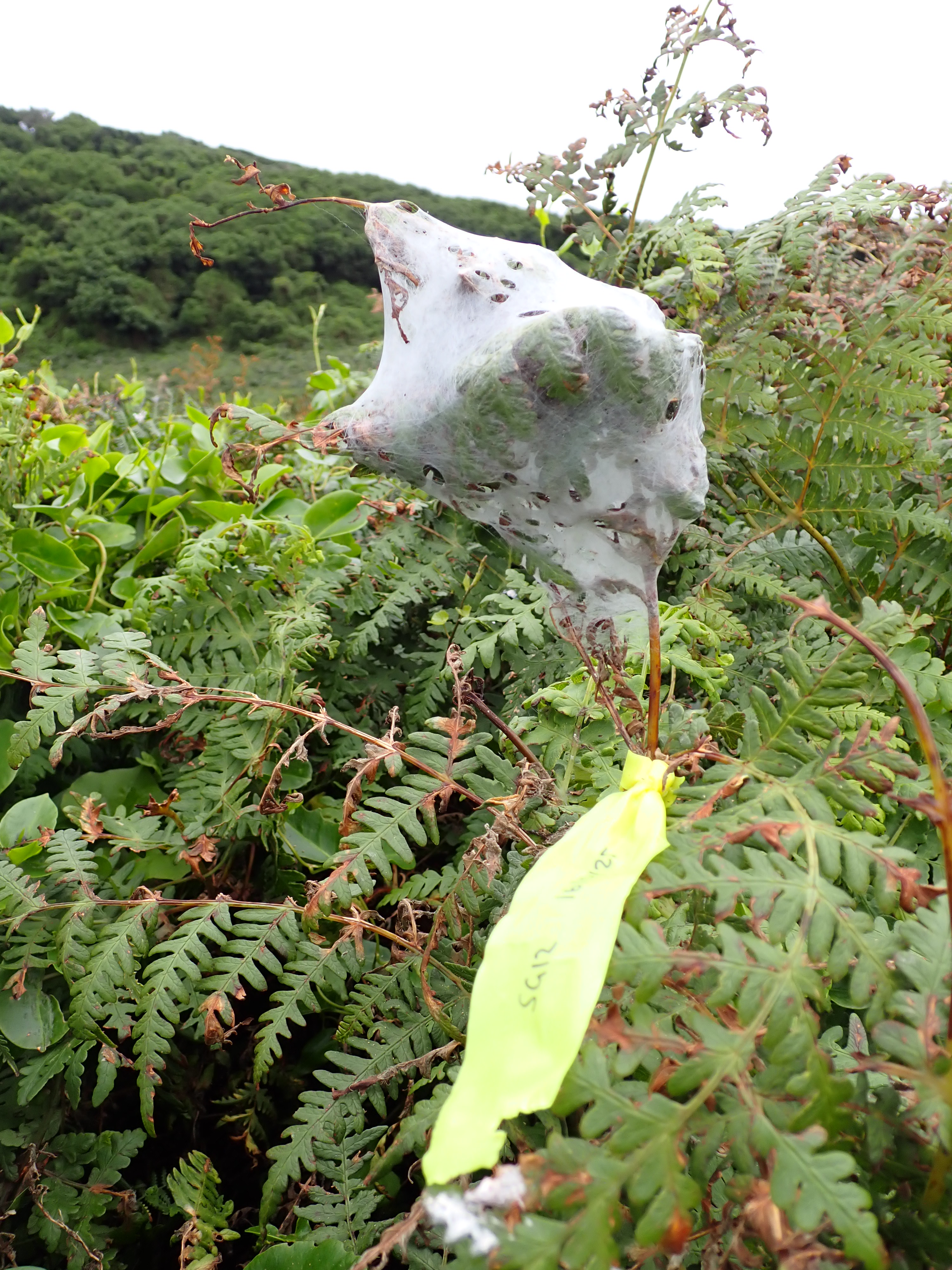
A female Rangatira spider with her egg sacA nursery web – waiting for spiderlings to hatch
While most of my work is taking place in-situ, including monitoring of the spider population with mark-recapture methods since October and since January monitoring of their nursery webs as well, I am also conducting behavioural experiments, such as mating trials to get a more detailed understanding of their mating behaviour.
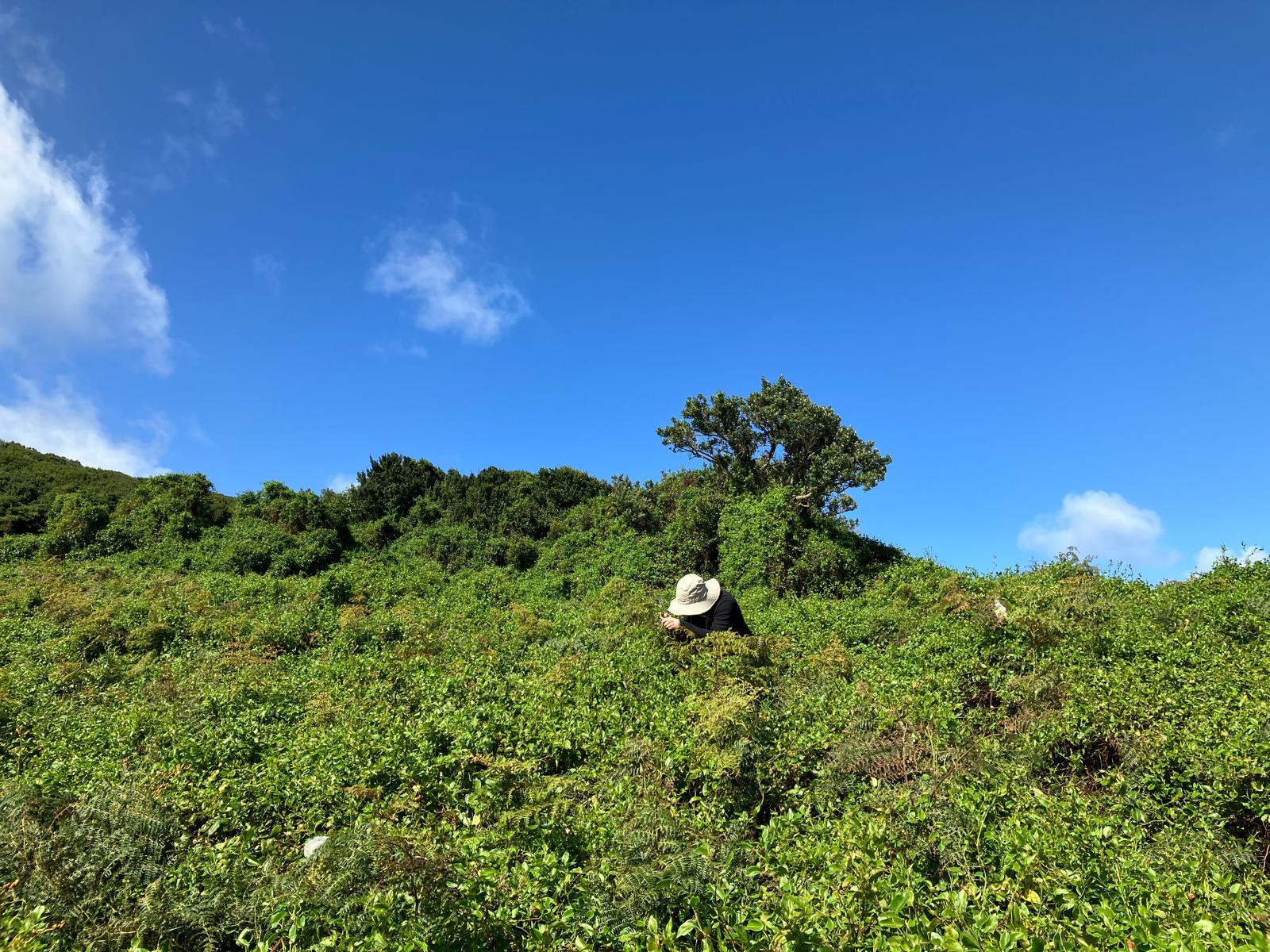
Zita observing a mama Rangatira spider guarding her babies at nightSearching for nursery webs in the scrub
The results of my fieldwork will give insights into the biology of this amazing species, and also help to get a better understanding of the different mating behaviours in Dolomedes fishing spiders.
It’s been a while since we sent an update from the Painting lab, but it’s not from lack of news. The lab has had lots of exciting things happen recently and we need to celebrate in this time of deep uncertainty in Aotearoa and the world.
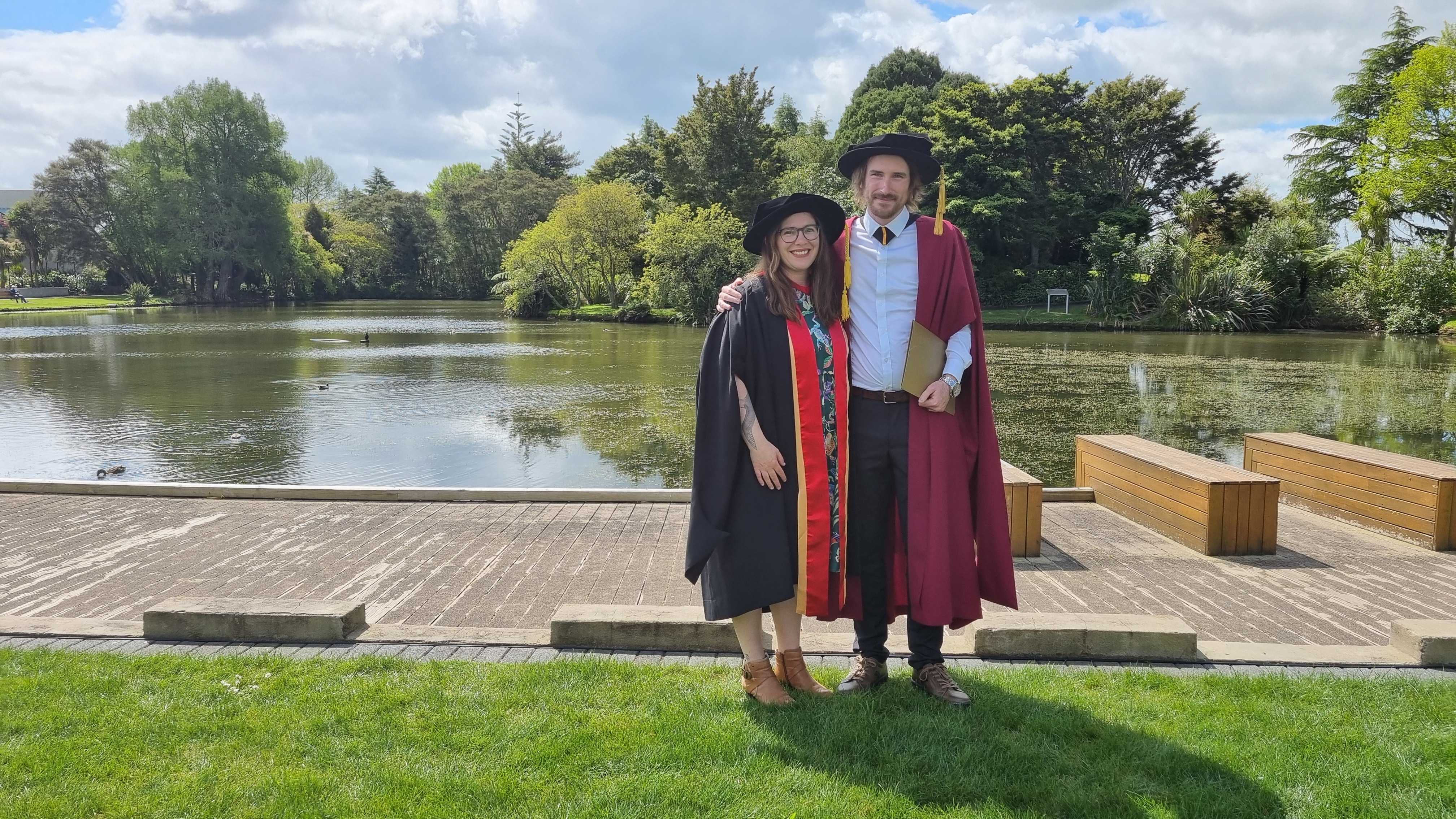
Firstly, in October we celebrated Simon’s PhD graduation at a beautiful ceremony in The Pā at the University of Waikato. Simon has since had both his first PhD paper published (see here) and has secured a job at Ecological Solutions. We’re proud of you Simon!
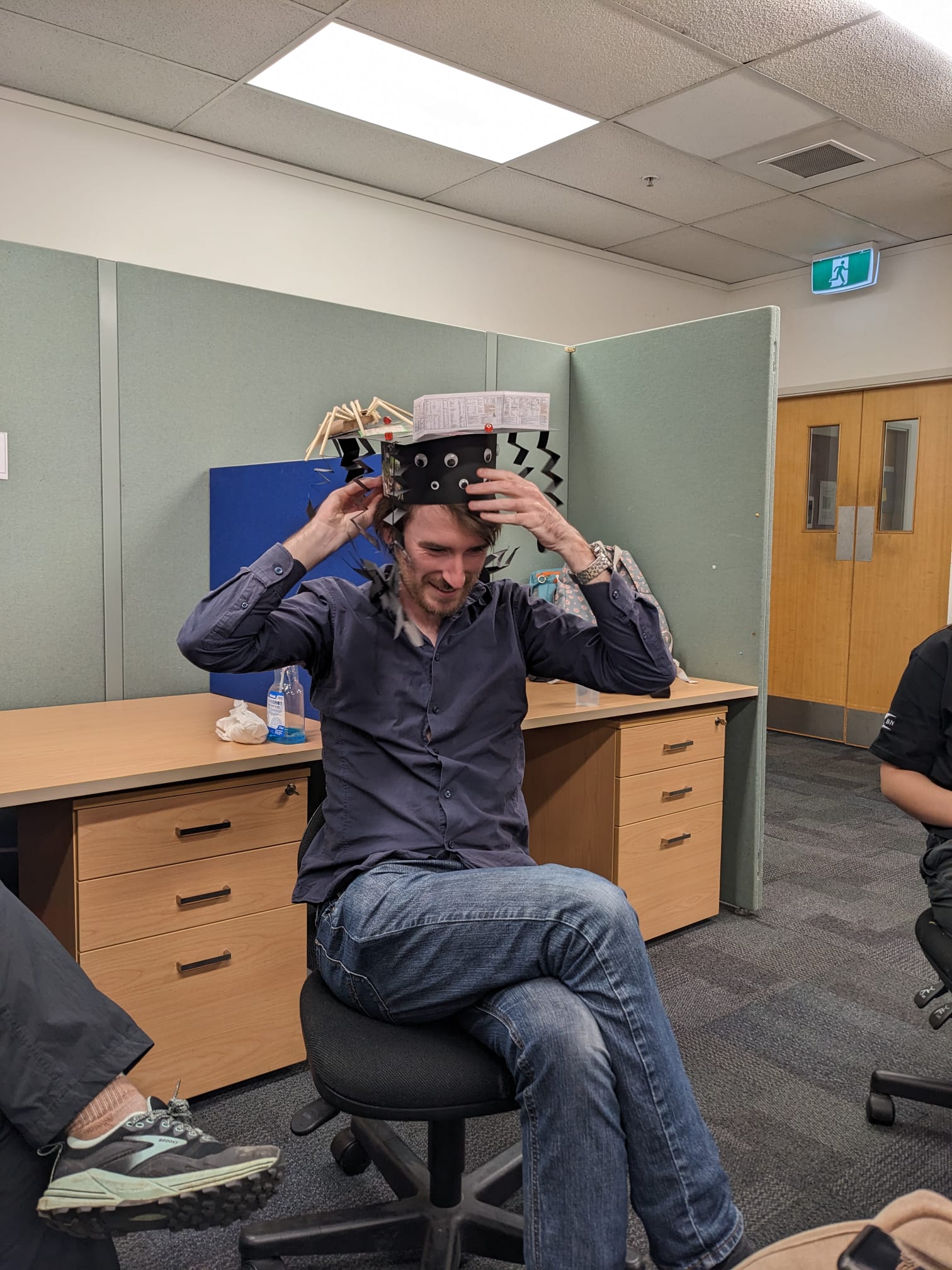
All dressed up Celebrating the oral defense with a very special hat
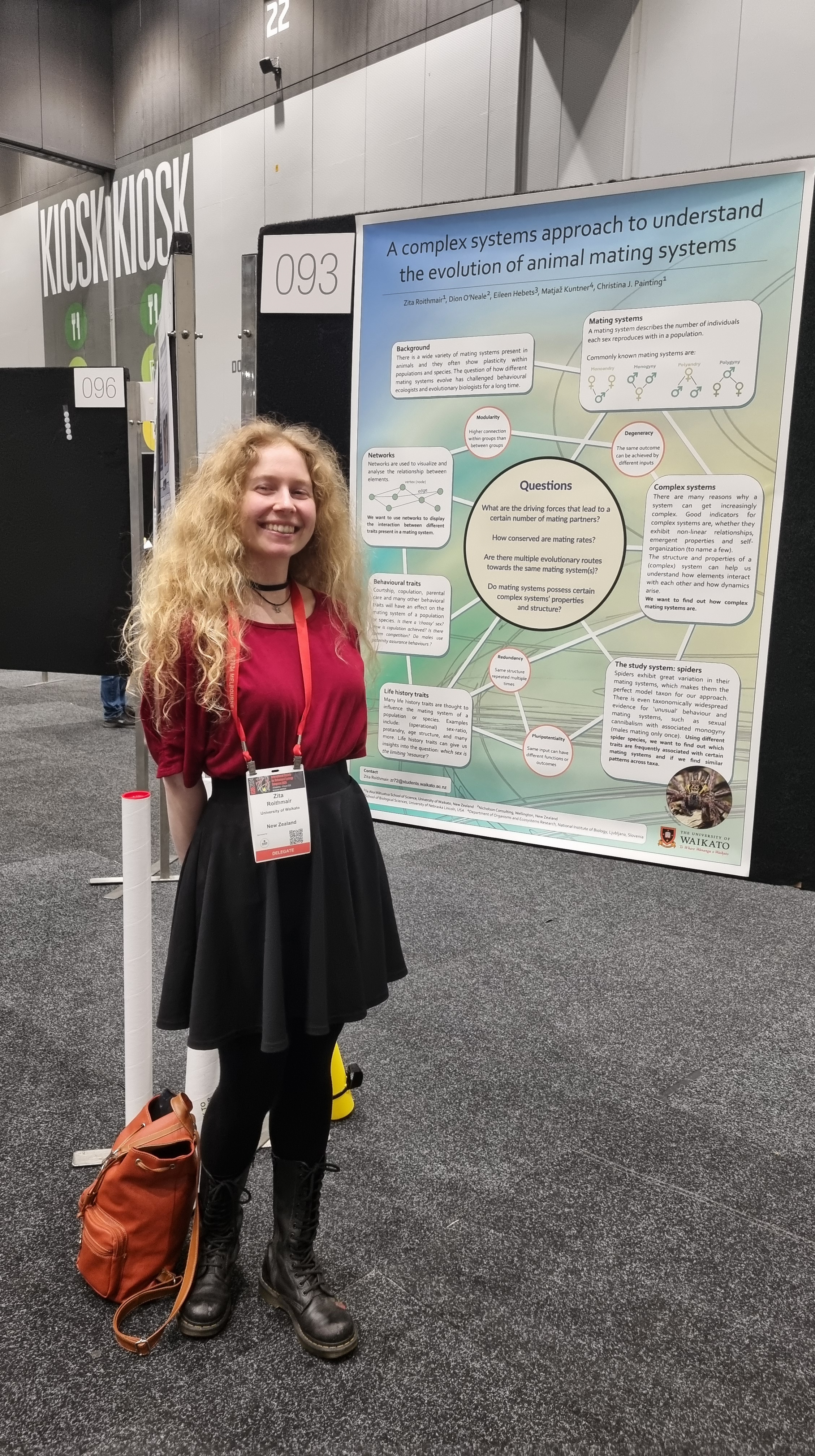
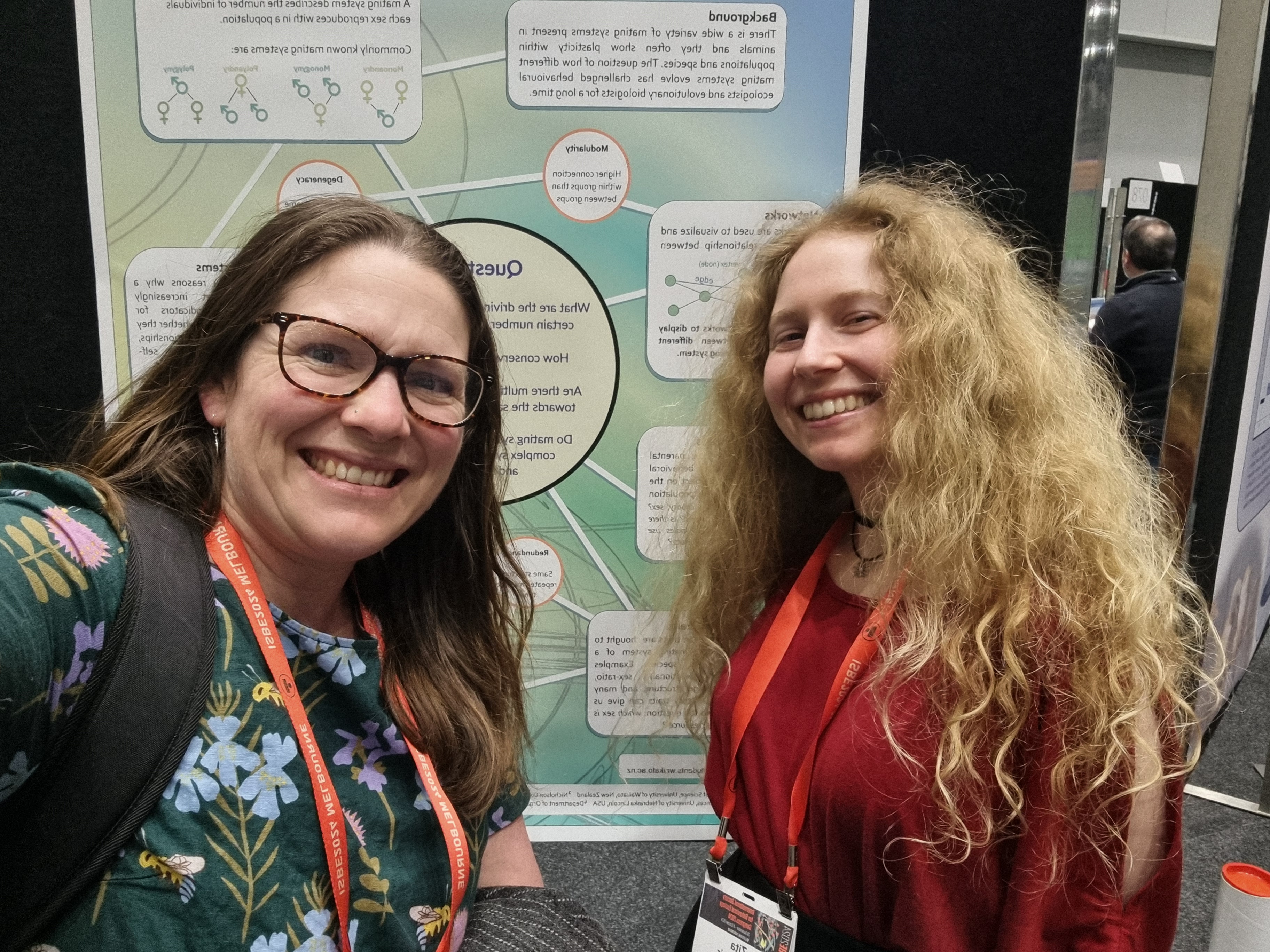
In October, Chrissie and Zita also spent a week in Naarm/Melbourne for the International Behavioural Ecology conference. Zita presented an excellent poster on the complex systems approach to studying mating systems that we are exploring, and we both had a great time connecting with other behavioural ecologists from around the world.
In December, Chrissie was awarded an inaugural Mana Tūānuku Research Leader Fellowship from the Royal Society. This is a really exciting opportunity to expand the research breadth of our group and seek new connections with community in Aotearoa and abroad. Chrissie will be exploring the interaction between natural and sexual selection from the impacts of climate change on cuticular hydrocarbons in NZ giraffe weevils.
Our group has also had a busy summer in the office, lab, and field, especially for our research on Dolomedes fishing spiders. Late last year our group published a review article on Dolomedes biology with our fabulous collaborators in Slovenia and the USA, co-first authored by PhD students Zita Roithmair and Kuang-Ping Yu. We hope this will be a really useful overview of what we know so far about these spiders, as well as generating a bunch of research avenues for the future.
Zita has also been busy on Hokorereoro/Rangatira island investigating the behaviour and ecology of one of our most special Dolomedes spiders. She’s spent most of the summer on this very remote island in the Chatham Island archipelago.
Zita with a very chunky female Rangatira spider
Zita has been joined on Hokorereoro/Rangatira island by Caleb, who is investigating the diet of karure/kakaruia/Chatham Island black robin and the invertebrate food availability across current and future translocation sites for this critically endangered bird. Caleb has completed the first stage of his field season and will head back to the Chatham Islands next week to do more invertebrate sampling and collecting robin poo for metabarcoding analysis.
Food provision delivery day is the best! (aka fresh fruit & veges!)
Back in mainland Aotearoa, Juniper has been rearing Dolomedes dondalei as part of her Masters research on their mating behaviour and ecology. She’s been doing regular monitoring of a population of fishing spiders in the Waikato and conducting mating experiments in the lab. Juniper has been joined by our wonderful summer scholarship student Han Logan, who has been integral in keeping our cricket colony alive, as well as doing some neat experiments investigating personality and anti-predator responses in the fishing spiders.
Juniper admiring a fishing spider at Tunakohoia streamHan forgetting that we’re studying spiders, not golden bell frogs
Last week, we also welcomed Aranturua Tao to the lab. Arnaturua is joining us from Hamilton East School under the Science Teaching Leadership Programme, administered by the Royal Society. Arnaturua will be joining in on all our lab activities to gain a deeper understanding of how we do science, so that she can strengthen the science curriculum at her primary school. Welcome Arnaturua!
Arnaturua joins our group
Finally, we are celebrating Epernay handing in her Masters thesis this week. Wahoo! Epernay has completed a fascinating project looking at the effects of population density on reproductive investment and physiology in honey bees. It is a fantastic example of a project that is both fundamentally insightful and practically important for the bee keeping industry. Epernay has also won several scholarships and talk prizes during her MSc(Research), and is a great communicator. Congratulations Epernay!
Epernay squeezing drone butts to extract a spermatophoreVery serious sciencing – extracting sperm for analysis
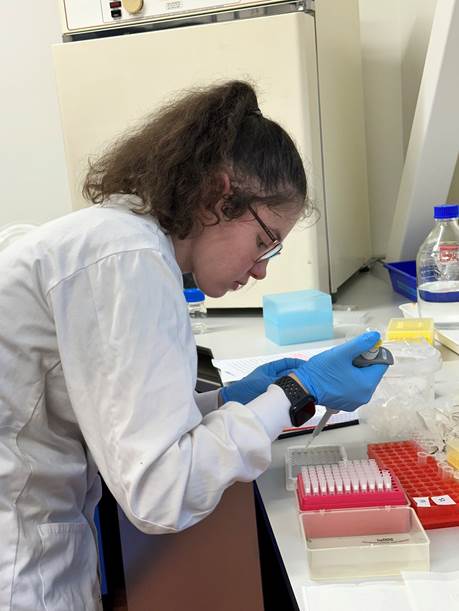
Congratulations to Epernay on winning a Waikato Graduate Women Educational Trust Masters Study Award! Phew that’s a mouthful! Epernay is doing her MSc(Research) with Chrissie and Ashley Mortensen at Plant & Food Research, investigating the ways honey bees respond to increases in sperm competition pressure. Epernay spent many hours in the lab analysing the sperm counts of drone bees from apiaries held at different densities, as well as days in the field counting drone comb at each colony. She’s now busy analysing all the findings and we’re excited to see in what ways (if any) the colony is responding to increased population density in regards to drone and sperm production.
Awesome work Epernay!
Drone (male) honey bee (Photo: Guillaume Pelletier: Wiki Commons)
Earlier this year, Chrissie took on the Senior Editor role at the New Zealand Journal of Zoology, which also coincided with the editing of a special issue on Animal Behaviour across New Zealand and the South Pacific. Together with guest editors Kristal Cain and Steph Godfrey, we invited researchers to submit papers and were delighted to end up with 16 contributions across a wide range of topics in animal behaviour. This included some fantastic buggy pieces on stick insects, wētā, and giraffe weevils. If you’d like to read a brief overview of the special issue and all the great contributions, you can check out our editorial: here. All the publications in this issue are open access, thanks to the Read & Publish agreement.
We’ve been celebrating the success of two of our group lately.
Firstly, a huge congratulations to Simon Connolly for handing in his PhD thesis for examination end of March. Simon has put together a fantastic piece of work on the mating behaviour and mechanisms of introgression on two Aotearoa New Zealand fishing spiders.
Secondly, Zita Roithmair successfully confirmed her enrollment last week & is now an official PhD student in the lab. Zita gave a really convincing seminar on why she’s exploring a complex systems approach to understanding the evolution of animal mating systems. Like Simon, she’ll be working on fishing spiders too, hopefully with some fun field work involved.
In October Chrissie and Zita were both lucky to spend time on the Chatham Islands. Zita will post an update on her amazing 3 weeks on Hokorereoro|Rangatira|South East Island later, but for now, check out Chrissie’s blog post (written with Tammy Steeves) for Te Pūnaha Matatini.
This month we welcome new PhD student Zita Roithmair to the Painting Lab. Zita comes to us from Vienna, Austria, where she has a background in zoology. Her MSc studied the morphology and diversity of sexually dimorphic characters in centipedes, and she is also currently in the final stages of completing a second MSc in Conservation and Ecology.
Zita will be working with Chrissie on the mating systems of Dolomedes fishing spiders, alongside Dion O’Neale (University of Auckland), Eileen Hebets (University of Nebraska-Lincoln), and Matjaž Kuntner (National Institute of Biology, Slovenia).
The joint Painting & EcoDiv lab celebrate Zita’s arrival
I have a confession to make. As an arachnologist, I have a lot of fondness for Spiderman. This webslinging hero does more for the image of my chosen species than any amount of science communication ever could. However, ever since I was a kid, my favourite superhero has been Gotham’s Dark Knight, the Caped Crusader…Batman. Which is the better superhero? Who would win in a fight? There’s really no way to know, but what we can figure out is which of these animal themed heroes represents their namesake best. Through this contest I will compare these two juggernauts of the genre and determine in a totally scientific and unbiased manner who is the most biologically accurate superhero! Grab your grappling hooks, it’s time for Batman vs Spiderman: Dawn of Biological Accuracy.
Our heroes ready for battle. Image by Addyspartacus
Round 1: Anatomy/Appearance
Basically, the question here is, who mimics their animal’s body the best? Now, clearly Batman is at something of an advantage here, by choosing an animal with the same number of legs as him…but let’s try and give Spidey a fair chance.
Spiderman does share a lot of biological characteristics with spiders. “Spiderman” 2002 clearly show his ability to climb walls comes from hooks and hairs on the ends of his limbs, and this version even has web-producing organs. However, it really does come down to that question of limbs, doesn’t it…and spiderman simply doesn’t have enough. “But Simon”, I hear you cry “Both Superior Spiderman and Tom Holland’s MCU Spiderman have robotic extra arms, bringing them up to 8 limbs! Surely that’s the right number!!” Well, whilst I thank you for the specificity of your references dear reader, you are incorrect. Spiders actually have 10 limbs (sort of). Next to their mouth, spiders have a pair of appendages known as pedipalps. Whilst small, they do look a lot like legs (in females at least) and are sometimes referred to as limbs. Spiders can use them for all sorts of things, usually handling food, though some females use them to carry their eggs around with them. Male spiders also house their genitals inside these pedipalps! In scorpions, these pedipalps actually make up the claws! So, in summary, Spiderman really should have 10 limbs, not 8. Batman on the other hand is the clear winner. He usually has bat-like wings and ears. He is “warm blooded” like a bat, and thanks to evolution, the bones in Bruce Wayne’s arm are the same as the bones in a bat’s wing…just shaped a little differently.
Batman 1 – 0 Spiderman
Vertebrates have very similar skeletons, modified for their particular lifestyle. We call these homologous structures.
Round 2: Abilities
Using their gadgets and powers, who can mimic their animals abilities the best?
This is where I must confess, I am not a bat scientist, so there may be some flaws in my analysis. However, Batman seems to be doing VERY well in this round. Bats are known for their abilities of flight, hearing/echolocation, and hanging upside down. Many versions of Batman can at least glide, and in “Batman Begins” and “The Dark Knight” we see him using gadgets to enhance his hearing and create images using sonar. In “Batman” 1989 and the Arkham video games, we even see Batman hanging upside down for long periods. However, is he as good as a bat? Could a gliding batman catch a moth in his mouth? Could he fly from a cave with thousands of other batmen and not crash into them? Unlikely.
Spiderman also does well here. As mentioned, he can create webs, climb on walls, and from trying to catch spiders I can tell you that they share his Spidey Sense. He also has “the proprtional speed and strength of a spider”, which depending in which spider you choose is probably accurate (though I once calulated that if he could run as fast as a Dolomedes spider, he should be able to run at over 200kph).
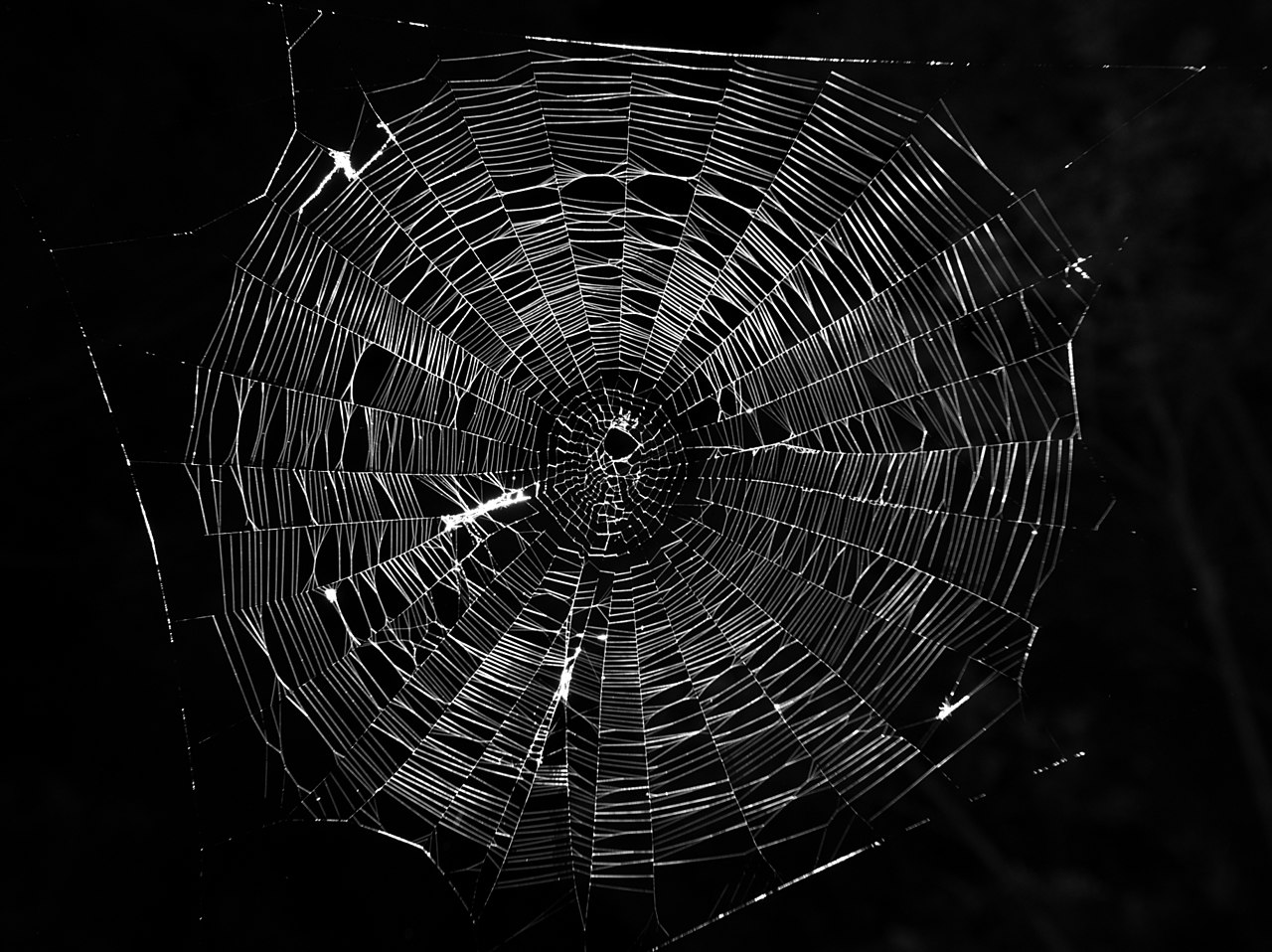
However, for this round, I’d like to discuss an underated ability of spiders: geometry. To build orbwebs, spiders have the incredible ability to construct a complex geometric shape in 3D space and modify its design to suit their environment! This is a kind of intelligence we don’t usually think about in animals…but it’s an intelligence Peter Parker possesses. In “Spiderman: No Way Home” Spiderman battles Doctor Strange in the Mirror Dimension. How does he win? He realises the Mirror Dimension is “just geometry, you’re great at geometry” and catches the sorcerer supreme in a web. So yes, Spiderman wins this round because Peter Parker is a geometry nerd.
Batman 1 – 1 Spiderman
A spider orbweb. Photo by Chen-Pan Liao on Wikipedia Commons
Round 3: Villains
Any C-list superhero will tell you that a hero is only as cool as his villains…but do the villains that that Batman and Spiderman face represent the natural enemies of their animals? Well, let’s go through some of their most popular villains and see what we can find.
Batman: The Joker (nope), The Riddler (whilst bats are probably bad at Riddles…no), Bane (no), Scarecrow (…hmmmm, no), Two Face (Bats have very few rights in the legal system), Poison Ivy (maybe…), Catwoman…ah hah!! Right here in Aotearoa cats are a threat to our endangered bats!
Spiderman: Doctor Octopus (Octopuses don’t meet many spiders, I don’t think),The Green Goblin (give me a break), Mysterio (oh, that hologram loser), Sandman (NO), Electro (…not really), The Lizard (Yes!). As relatively large vertebrates, lizards would definitely love eating spiders!
So both heroes have at least 1 villains who would be a threat to their animal of choice. BUT…is Catwoman really a villain? The Lizard actually tries to kill and eat Spiderman most of the time…so I will give the point to Spiderman here!
Batman 1 – 2 Spiderman
Spiderman wins! He is officially the most biologically accurate hero!
“You just end up with a sixth sense for where your species will be.”, said my supervisor nearly three years ago. As with most things, Chrissie ended up being right about this (and I’m not just saying that because her website hosts this blog)! My PhD work has had me travelling up and down the country hunting for two spider species.
In some cases, this meant arriving in a remote part of the South Island, with only 7 days to collect hundreds of spiders from sites I had never been to before! The first time I tried this, I struggled. I wandered up and down field sites with no idea what I was looking for. Hours upon hours of my precious time wasted in places with the same number of spiders you’d find on the surface of the Moon! However, three years on, having learnt the hard way, I have developed that sixth sense that Chrissie spoke of, my Spidey Sense, if you will.
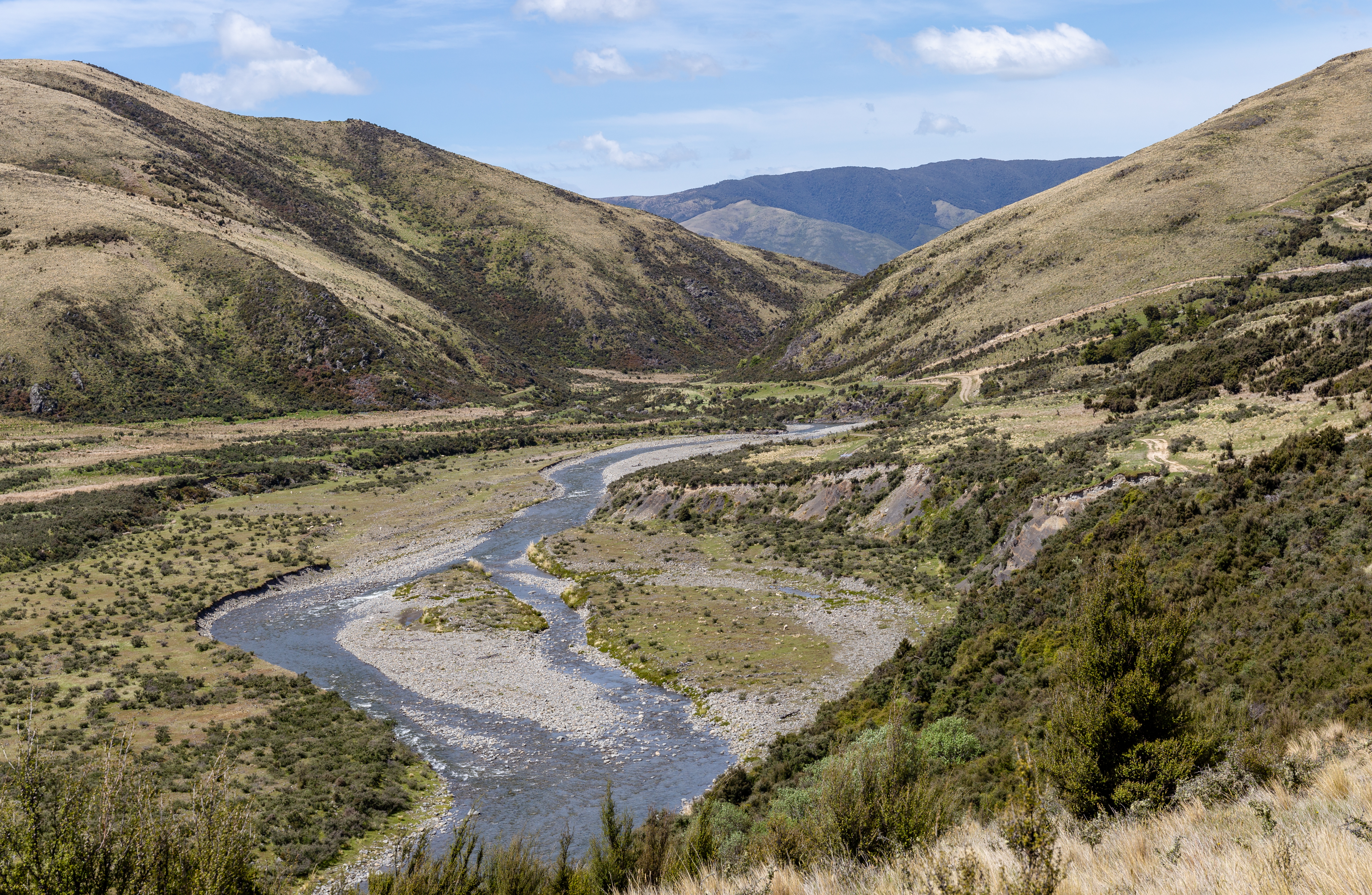
Looking at a site, I can tell you whether you will find my target species there. The terrain, elevation, the structure of the plant species, these all provide useful information. However, it’s all in a way that is difficult to describe. For example, I can tell you that Dolomedes minor likes shrubby habitats, and that Dolomedes aquaticus likes rocky rivers. I can also tell you that aquaticus needs rivers with a little elevation and plant life to them, so they don’t all get washed away in the first bit of rain. But there’s also a certain ineffable quality. Something unquantifiable that exists in a good site. Something that reaches out into the subconcious part of my brain and whispers “there are spiders here.” In the same way that Spiderman knows that danger is nearby but can’t tell you what, I can tell you that spiders are nearby…but can’t tell you why.
Ashley River, Canterbury, NZ
This spidey sense has also completely ruined my brain! I can’t go for a walk without seeing a patch of shrubs that I know must teem with spiders. I see a picture of a riverbend, and I know the precise spot where I’d look for eight legged friends! I simply cannot turn off this knowledge. There is only so many times my friends and loved ones want their relaxing walks interrupted by the words “I reckon there’s spiders in that bush.”
And now here is the dilemma. I will not be the last to carry this (modest) burden. Even now, I am helping train an intern to find another species of spider. And after him, there will be other students and PhD candidates. If I myself am to continue in this field, I may yet have to develop my senses to look for more species. Should they be cursed…as I have been.
I mean probably, I am being quite melodramtic here… but if…with great power comes great responsibility, then perhaps with great knowledge comes great annoyance.











 Invertebrate Behavioural Ecology Lab