Something Something Science: Batman vs Spiderman

Dawn of Biological Accuracy

I have a confession to make. As an arachnologist, I have a lot of fondness for Spiderman. This webslinging hero does more for the image of my chosen species than any amount of science communication ever could. However, ever since I was a kid, my favourite superhero has been Gotham’s Dark Knight, the Caped Crusader…Batman. Which is the better superhero? Who would win in a fight? There’s really no way to know, but what we can figure out is which of these animal themed heroes represents their namesake best. Through this contest I will compare these two juggernauts of the genre and determine in a totally scientific and unbiased manner who is the most biologically accurate superhero! Grab your grappling hooks, it’s time for Batman vs Spiderman: Dawn of Biological Accuracy.

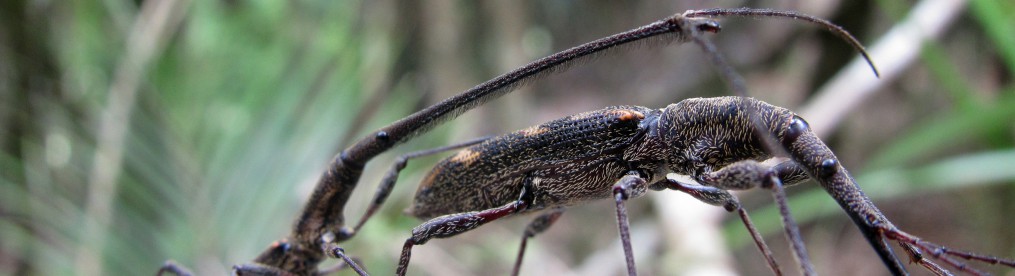
Our heroes ready for battle. Image by Addyspartacus

Round 1: Anatomy/Appearance

Basically, the question here is, who mimics their animal’s body the best? Now, clearly Batman is at something of an advantage here, by choosing an animal with the same number of legs as him…but let’s try and give Spidey a fair chance.

Spiderman does share a lot of biological characteristics with spiders. “Spiderman” 2002 clearly show his ability to climb walls comes from hooks and hairs on the ends of his limbs, and this version even has web-producing organs. However, it really does come down to that question of limbs, doesn’t it…and spiderman simply doesn’t have enough. “But Simon”, I hear you cry “Both Superior Spiderman and Tom Holland’s MCU Spiderman have robotic extra arms, bringing them up to 8 limbs! Surely that’s the right number!!” Well, whilst I thank you for the specificity of your references dear reader, you are incorrect. Spiders actually have 10 limbs (sort of). Next to their mouth, spiders have a pair of appendages known as pedipalps. Whilst small, they do look a lot like legs (in females at least) and are sometimes referred to as limbs. Spiders can use them for all sorts of things, usually handling food, though some females use them to carry their eggs around with them. Male spiders also house their genitals inside these pedipalps! In scorpions, these pedipalps actually make up the claws! So, in summary, Spiderman really should have 10 limbs, not 8. Batman on the other hand is the clear winner. He usually has bat-like wings and ears. He is “warm blooded” like a bat, and thanks to evolution, the bones in Bruce Wayne’s arm are the same as the bones in a bat’s wing…just shaped a little differently.

Batman 1 – 0 Spiderman

Vertebrates have very similar skeletons, modified for their particular lifestyle. We call these homologous structures.

Round 2: Abilities

Using their gadgets and powers, who can mimic their animals abilities the best?

This is where I must confess, I am not a bat scientist, so there may be some flaws in my analysis. However, Batman seems to be doing VERY well in this round. Bats are known for their abilities of flight, hearing/echolocation, and hanging upside down. Many versions of Batman can at least glide, and in “Batman Begins” and “The Dark Knight” we see him using gadgets to enhance his hearing and create images using sonar. In “Batman” 1989 and the Arkham video games, we even see Batman hanging upside down for long periods. However, is he as good as a bat? Could a gliding batman catch a moth in his mouth? Could he fly from a cave with thousands of other batmen and not crash into them? Unlikely.

Spiderman also does well here. As mentioned, he can create webs, climb on walls, and from trying to catch spiders I can tell you that they share his Spidey Sense. He also has “the proprtional speed and strength of a spider”, which depending in which spider you choose is probably accurate (though I once calulated that if he could run as fast as a Dolomedes spider, he should be able to run at over 200kph).

However, for this round, I’d like to discuss an underated ability of spiders: geometry. To build orbwebs, spiders have the incredible ability to construct a complex geometric shape in 3D space and modify its design to suit their environment! This is a kind of intelligence we don’t usually think about in animals…but it’s an intelligence Peter Parker possesses. In “Spiderman: No Way Home” Spiderman battles Doctor Strange in the Mirror Dimension. How does he win? He realises the Mirror Dimension is “just geometry, you’re great at geometry” and catches the sorcerer supreme in a web. So yes, Spiderman wins this round because Peter Parker is a geometry nerd.

Batman 1 – 1 Spiderman
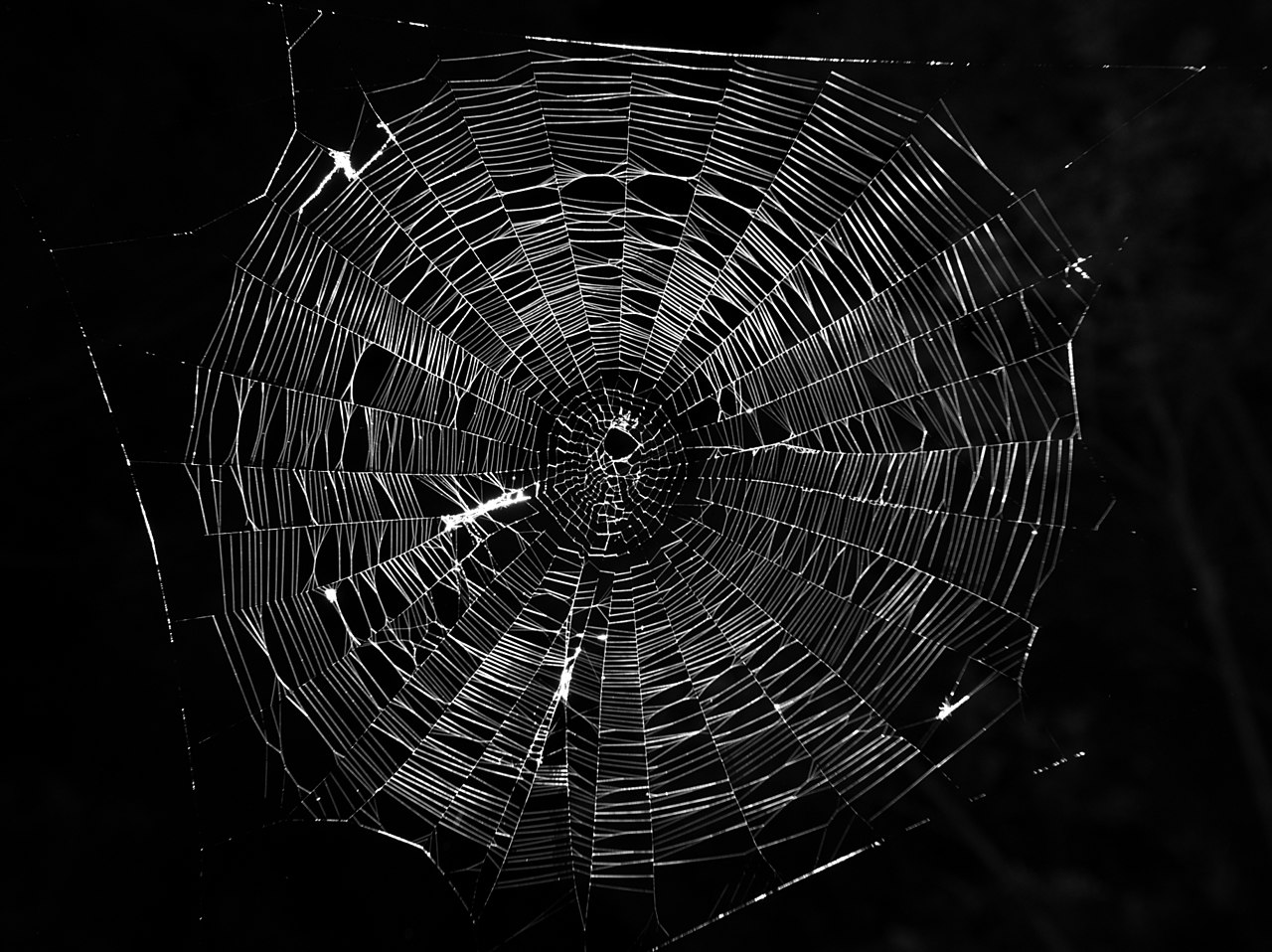
A spider orbweb. Photo by Chen-Pan Liao on Wikipedia Commons

Round 3: Villains

Any C-list superhero will tell you that a hero is only as cool as his villains…but do the villains that that Batman and Spiderman face represent the natural enemies of their animals? Well, let’s go through some of their most popular villains and see what we can find.

Batman: The Joker (nope), The Riddler (whilst bats are probably bad at Riddles…no), Bane (no), Scarecrow (…hmmmm, no), Two Face (Bats have very few rights in the legal system), Poison Ivy (maybe…), Catwoman…ah hah!! Right here in Aotearoa cats are a threat to our endangered bats!

Spiderman: Doctor Octopus (Octopuses don’t meet many spiders, I don’t think),The Green Goblin (give me a break), Mysterio (oh, that hologram loser), Sandman (NO), Electro (…not really), The Lizard (Yes!). As relatively large vertebrates, lizards would definitely love eating spiders!

So both heroes have at least 1 villains who would be a threat to their animal of choice. BUT…is Catwoman really a villain? The Lizard actually tries to kill and eat Spiderman most of the time…so I will give the point to Spiderman here!

Batman 1 – 2 Spiderman

Spiderman wins! He is officially the most biologically accurate hero!

Batman is still cool tho.

Something Something Science: Developing my Spidey Sense

“You just end up with a sixth sense for where your species will be.”, said my supervisor nearly three years ago. As with most things, Chrissie ended up being right about this (and I’m not just saying that because her website hosts this blog)! My PhD work has had me travelling up and down the country hunting for two spider species.

In some cases, this meant arriving in a remote part of the South Island, with only 7 days to collect hundreds of spiders from sites I had never been to before! The first time I tried this, I struggled. I wandered up and down field sites with no idea what I was looking for. Hours upon hours of my precious time wasted in places with the same number of spiders you’d find on the surface of the Moon! However, three years on, having learnt the hard way, I have developed that sixth sense that Chrissie spoke of, my Spidey Sense, if you will.

Looking at a site, I can tell you whether you will find my target species there. The terrain, elevation, the structure of the plant species, these all provide useful information. However, it’s all in a way that is difficult to describe. For example, I can tell you that Dolomedes minor likes shrubby habitats, and that Dolomedes aquaticus likes rocky rivers. I can also tell you that aquaticus needs rivers with a little elevation and plant life to them, so they don’t all get washed away in the first bit of rain. But there’s also a certain ineffable quality. Something unquantifiable that exists in a good site. Something that reaches out into the subconcious part of my brain and whispers “there are spiders here.” In the same way that Spiderman knows that danger is nearby but can’t tell you what, I can tell you that spiders are nearby…but can’t tell you why.

Ashley River, Canterbury, NZ

This spidey sense has also completely ruined my brain! I can’t go for a walk without seeing a patch of shrubs that I know must teem with spiders. I see a picture of a riverbend, and I know the precise spot where I’d look for eight legged friends! I simply cannot turn off this knowledge. There is only so many times my friends and loved ones want their relaxing walks interrupted by the words “I reckon there’s spiders in that bush.”

And now here is the dilemma. I will not be the last to carry this (modest) burden. Even now, I am helping train an intern to find another species of spider. And after him, there will be other students and PhD candidates. If I myself am to continue in this field, I may yet have to develop my senses to look for more species. Should they be cursed…as I have been.

I mean probably, I am being quite melodramtic here… but if…with great power comes great responsibility, then perhaps with great knowledge comes great annoyance.

Welcome to: Something Something Science

“Something Something Science” is a new, occasional blog series by me, Simon Connolly. I am a (hopefully) final year PhD candidate, and I will be sharing my expertise on insects, spiders and other cool scientific topics. I will also share my opinions on discussions in the science discourse and media, through my perspective as an early career scientist!

You don’t need to be a scientist to enjoy this, and even if you are, you might still learn something! So…scroll on down for the first post in this new series…

Something Something Science: “I’m a Doctor, not a Comedian”

Science, Fun and Pop Culture References

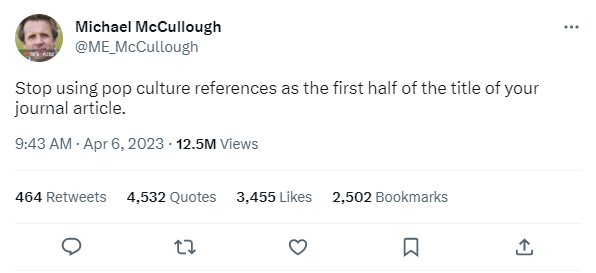
“Stop using pop culture references as the first half of the title of your journal article.” This a recent tweet by Michael McCullough, a California based psychologist and author. The response from the twitter scientific community has been overwhelmingly… sarcastic.

Many scientists have replied with their own papers that bear such titles: “#SoMe the Money! Value, Strategy, and Implementation of Social Media Engagement for Infectious Diseases Trainees, Clinicians, and Divisions” and “Sharks on a plane: Large shark fin seizure shines light on shark exploitation.” Others have simply replied with mock titles for articles on the subject: “Stop Making Sense: A Multi-pronged Analysis Of The Futility of Giving Academic Advice Over Twitter”, “I’m just here for the replies: An observational study of the Twitter roast of killjoy professors.”, or the truly perfect “Never Gonna Give You Up: The Use of Pop Culture References in Journal Article Titles.”

Whilst I’m sure we can all agree that these are ‘sick burns’, it does lead to the question of why people feel so strongly about this. The original tweet might seem like a fairly innocuous opinion that has been met with an avalanche of (mostly humourous and well intentioned) responses. I believe that this tweet cuts to the core of a source of tension in the scientific community, and a key question as to how science should be communicated.

But first, let’s talk about science writing, or more specifically journal articles. The journal articles that McCullough refers to are the main way that scientists communicate results, and are read by other scientists when building their own work. They are also, often, quite dry reading. They involve a dispassionate summary of current knowledge; a detailed explanation of how an experiment or study was conducted; a description of the statistics involved; a detailed breakdown of the outcome of those statistics; followed by a robust discussion of the implications of the findings on the scientific world. Can all of these aspects be exciting to the right people? Of course! But there is a reason why you won’t find these articles in the magazine stand at the supermarket, or on the homepage of Buzzfeed. Science writing is often dense and tedious. Poor writing also compounds these problems. Many scientists habitually rely on words like “heretofore’, “moreover”, “correspondingly” and “notwithstanding”, that are used to create overly-verbose, overly-long word vectors that utilise advanced nomenclature and terminology to create a false sense of intelligence and academic rigour, either deliberately or simply incidentally (in other words, scientists use a lot of big words to make themselves sound smart). I am certainly guilty of this too.

The tediousness of scientific papers has created a whole ecosystem of science communicators, journalists, TED talks, podcasts, and blog posts (hello there), which exist to communicate science to a general audience (hopefully without boring them to tears!!). All of this is great, and science communication is an incredibly valuable field! But what about the scientists? What about the people who have to read dozens of journal articles a week, as well as writing their own. Should they not be allowed to have a little fun?

Well, some of us do, by adding little pop culture references to our article titles, and little jokes to our writing. However, others argue that this is unprofessional. These science purists (AKA, the fun-police) argue that the purpose of scientific articles is PURELY to communicate the science, and not to entertain the audience reading it. Many point to legitimate concerns such as excluding those who are not “in on the joke”, an overuse of low hanging fruit (in 2005 there were over 4000 uses of “To be or not to be”) or that there is evidence that articles with pop-culture titles are actually cited less by other scientists (though this could be because the “fun-police scientists” don’t want to engage with these works)! However, I think to dismiss the idea entirely, misses the point.

Something that is fun to read is going to be easier to read. A little joke title can go a long way to getting your audience engaged with the work. A well chosen reference can also be an excellent way to communicate complex information. For example, an article entitled: “The hidden diversity of dimorphic fungal pathogens” sort of tells you what the article is about…however, if you change the title to “Fantastic yeasts and where to find them: the hidden diversity of dimorphic fungal pathogens” the audience immediately knows what the paper is about! We’re going on a fantastic yeast hunt, and honestly, who wouldn’t want to!?

But, the other thing to consider is that scientists are human. We like fun, often silly things. We want our jobs to have moments of levity, especially during tasks that are often bland. Pop culture is also a huge part of who many of us are, and speaks to why we became scientists in the first place. I would be a liar of I said that part of the reason I want to complete my PhD is so I can say “I’m a doctor, not a…” at every possible opportunity. And I think many of my peers are inspired by scientists in pop-culture (both fictional and not). To ask for the wholesale removal of these references from people’s work is doing a disservice to the fun-loving, science-loving people who write them.

But of course: that’s just like, my opinion man!