Spiders at the Xishuangbanna Tropical Botanic Garden

June was a busy month for the spider lab. After a week spent frantically setting up all our new spider pets in the lab and getting experiments underway we packed our bags again and took off to south west China. Our destination was the Xishuangbanna Tropical Botanic Garden (XTBG) which is found next to a small town called Menglun in the Yunnan province. The gardens are so well tucked away in the south west corner of China that you can just about peek over the border to Laos, with Myanmar not far away on its western side either.

XTBG is surrounded by a large river, with multiple bridges crossing it at various points, connecting both the local town and the large research institute associated with the gardens. We stayed in a hotel in Menglun and walked each day across a big suspension bridge into the garden after a delicious breakfast of rice noodles in a soup packed with herbs and spices.

blog 1

View from the suspension bridge to the gardens (left), Daily breakfast of rice noodles with herbs & spices (right)

One of our goals was to collect Siler semiglaucus jumping spiders, the focal species for PhD student Zeng Hua. Siler are tiny but covered in intricately colourful patches. Zeng Hua doesn’t know yet what the role of all these colours are but she aims to find out and is particularly interested in how they are used by males to advertise to females during courtship. Siler semiglaucus and other species in this genus are quite common around much of South East Asia and China, including Singapore, and worth keeping a look out for next time you are in this part of the world. Keep your eye out on park-land shrubs and trees; we’ve had particular luck finding them in long grass.

siler m and f

Siler semiglaucus male (left) and female (right). Note the fluffy patches on the males forelegs that he waves around during courtship.

During our time at the gardens we were hosted by Prof Yang Xiaodong, a scientist based at the XTGB Chinese Academy of Sciences. Daiqin and I were both invited to give seminars about our research, and luckily I had a few slides on the ready so took Prof Yang up on the offer. The only problem was that not only was I lacking any professional looking clothes to wear, the clothes I did have smelt like I had been in the field for days (because I had), but hopefully the giraffe weevil videos distracted everyone.

DSC_0448

Hopefully not boring everyone about giraffe weevils & their friends

After our talks we were invited to an amazing banquet with a bunch of other scientists based at the XTBG. This was just one of many feasts we took part in during the week including a wonderful spread put on by ladies at a local Dai restaurant. Dai people are an ethnic minority in China and live predominantly in the Xishuangbanna area. Here they eat a lot of delicious wild vegetables (fern fronds, various roots etc) with their staple sticky rice. I also found their housing really interesting too, which usually comprised of two stories with the upper level dedicated to living space and the lower level used for storing livestock (we mostly saw chickens), food and transport.

dai food

Preparing the 3 types of sticky rice (left), Enjoying Dai food on our last evening in XTGB (right)

dai village 3

A Dai village near Menglun

One of the highlights of the trip was discovering the fireflies flashing their glowing abdomens as they emerged during the evenings on our walks home from the gardens. Fireflies have a slightly misleading name, because rather than being a fly, the mysterious glowing light belongs to several types of beetle families including the Lampyridae, Phengodidae, and Rhagophthalmidae. All of these beetles belong to the larger super family of Elateroidea, of which most familiar to many would be the click beetles. Fireflies use their distinctive flashing signals to locate mates of the right species, which is important when several species are flying around at the same time. Unfortunately I didn’t get any pictures but can recommend this great video which shows timelapse videos of fireflies in the night sky.

Another fun find was this ant-mimicking crab spider (Amyciaea forticeps). Like so many spiders, this species mimics ants and in this case the mimicry is specific to weaver ants (Oecophylla smaragdina). Morphological adaptations to looking ant-like are called myrmecomorphy and there are hundreds of examples of these among spiders.

crab spiders

Ant-mimicking crab spider – check out the eye spots on the spiders abdomen (right)

There are several Amyciaea species like the one we found in China around the world, and there are multiple species that mimic Oecophylla smaragdina. In Australia this species of weaver ant has green gasters (the bulbous bit at the end of an ant’s body), but in Asia the gasters are red. Interestingly, the colour of the crab spiders in these two regions of the world match the colour of the ants; in Australia A. albomaculata is green, while in Asia other Amyciaea are orange/red (like the one we found, above).

Although not much work has been done on Amyciaea spiders, they appear to be “aggressive mimics“. This means that they mimic weavers ants so that they can blend in among an ant colony and use these ants as food. As well as matching the colour of weaver ants, Amyciaea also have two black dots on their abdomen which look like ant eyes and move in a jerky ant-like fashion.

Aggressive mimicry among spiders is not very common; most examples are considered Batesian mimics, where the spiders look like ants to avoid predators. Many predators have a strong aversion to ants because they can be dangerous; they can sting, bite and spray acid as well as  being able to recruit their nest-mates to launch an attack on invading predators. Ants, therefore, are a useful model for a spider to look like if it means avoiding a larger suite of predators. One of the most predominant groups of Batesian ant-mimicking spiders are the Myrmarachne, of which there are about 200 species.
ant mimics 4

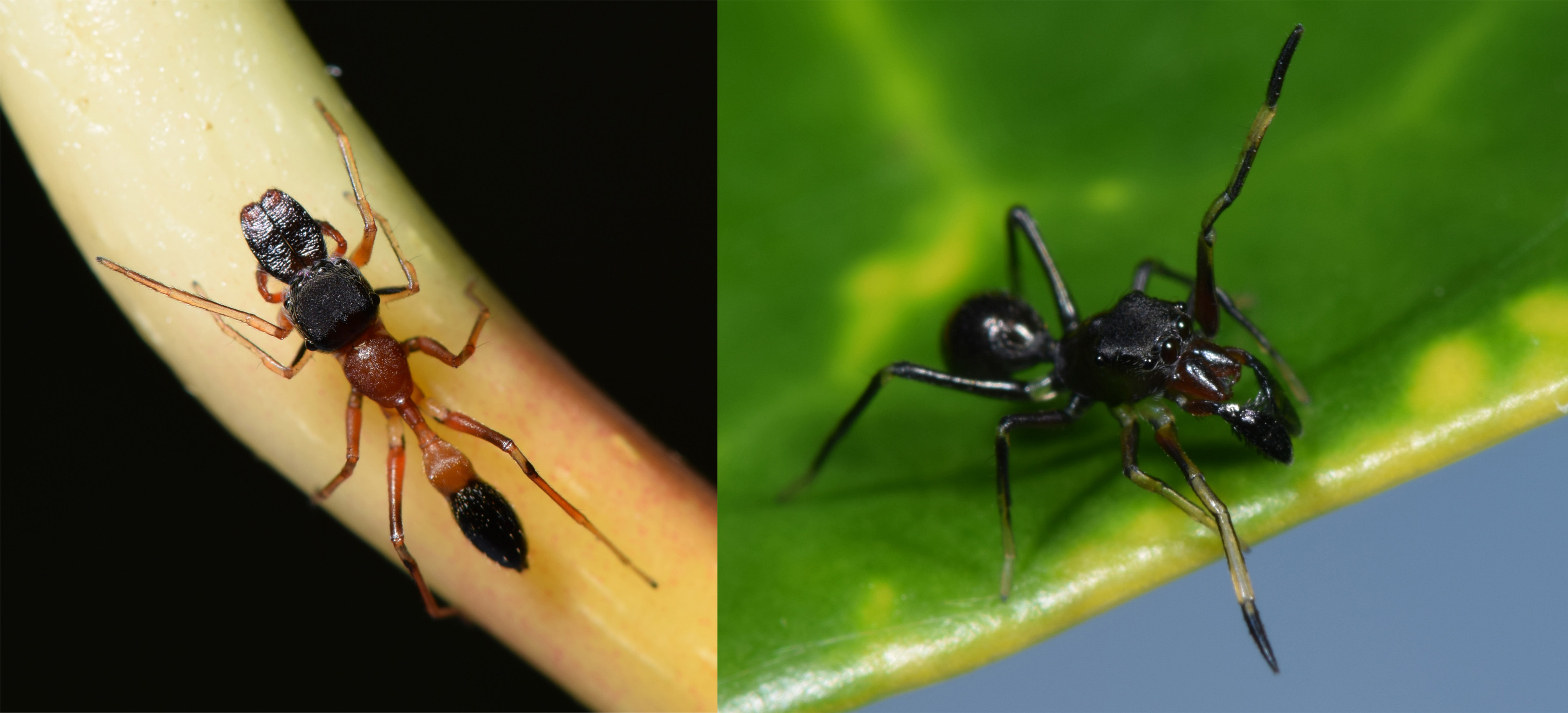
Two species of Myrmarachne that we collected in Malaysia

We commonly see Myrmarachne around Singapore, and on both of our spider collecting trips abroad. Like many ant-mimicking spiders, Myrmarachne have a constricted “waist” (their abdomen has a narrow part) and they usually wave their front legs to resemble ant antennae. The way they move is also distinctly ant-like, in that they run in jerky little bursts. All of this make them really tricky to distinguish from an ant and it has taken me a while to be able to spot them among their ant models.

Myrmarachne also tend to be highly sexually dimorphic, meaning that the males and females look different. Among these ant mimics the dimorphism is due to males often having very enlarged chelicerae (jaws), while in females they are comparatively reduced. These enlarged chelicerae sticking out of the front of a male’s head should make them less convincing mimics. However, it is hypothesised that males are still able to deceive potential predators by looking like an ant carrying something in its mouth (like a seed or piece of dead insect).

Sure enough, when Ximena Nelson and Robert Jackson at the University of Canterbury looked at predation rates on male versus female Mrymarachne spiders, they confirmed that males are still convincing mimics. Both male and female Mrymarachne were avoided by Portia, a spider which will hunt other spiders but avoids ants. However, when they did a similar experiment presenting Mrymarachne to an ant-eating spider they found that males were targeted more often than females, probably because they are perceived to be an easier catch by looking like an ant weighed down with food.

Not all ant-mimicking spiders look very convincingly like their models. Orsima ichneumon, the jumping spider from Malaysia that I am working on at present, has various ant-like features such as a constricted abdomen and erratic movement when running around the vegetation. They also have very elongated spinnerets (silk producing structures) at the tip of their abdomen which point in different directions such that one set looks like insect mouthparts, and the other like antennae. As the spider moves the spinnerets bob up and down on the substrate they are walking on making their rear-end look quite convincingly ant-like. These adaptations aside, what really makes Orsima stick out is their incredible colouration. These colours certainly take away from their ant-like appearance, and I am interested in how these colours (as well as their other morphological adaptations and behaviour) are selected for; what is important for mate choice (i.e. what are lady Orsima interested in) and what is used to avoid or deter predators? Hopefully I’ll know more about that soon!

Orsima ichneumon - an ant-mimicking spider?

Orsima ichneumon – an ant-mimicking spider?
Following the pipeline trail

Since we returned from China a couple of weeks ago (more on that in the next blog) I have been trying to get stuck into experiments. Although it is exciting to be collecting data, I’ve been locked in a windowless room most days and feeling a bit desperate to get outside for some fresh air. What better excuse to escape the lab than the need to head to the field for more spiders!

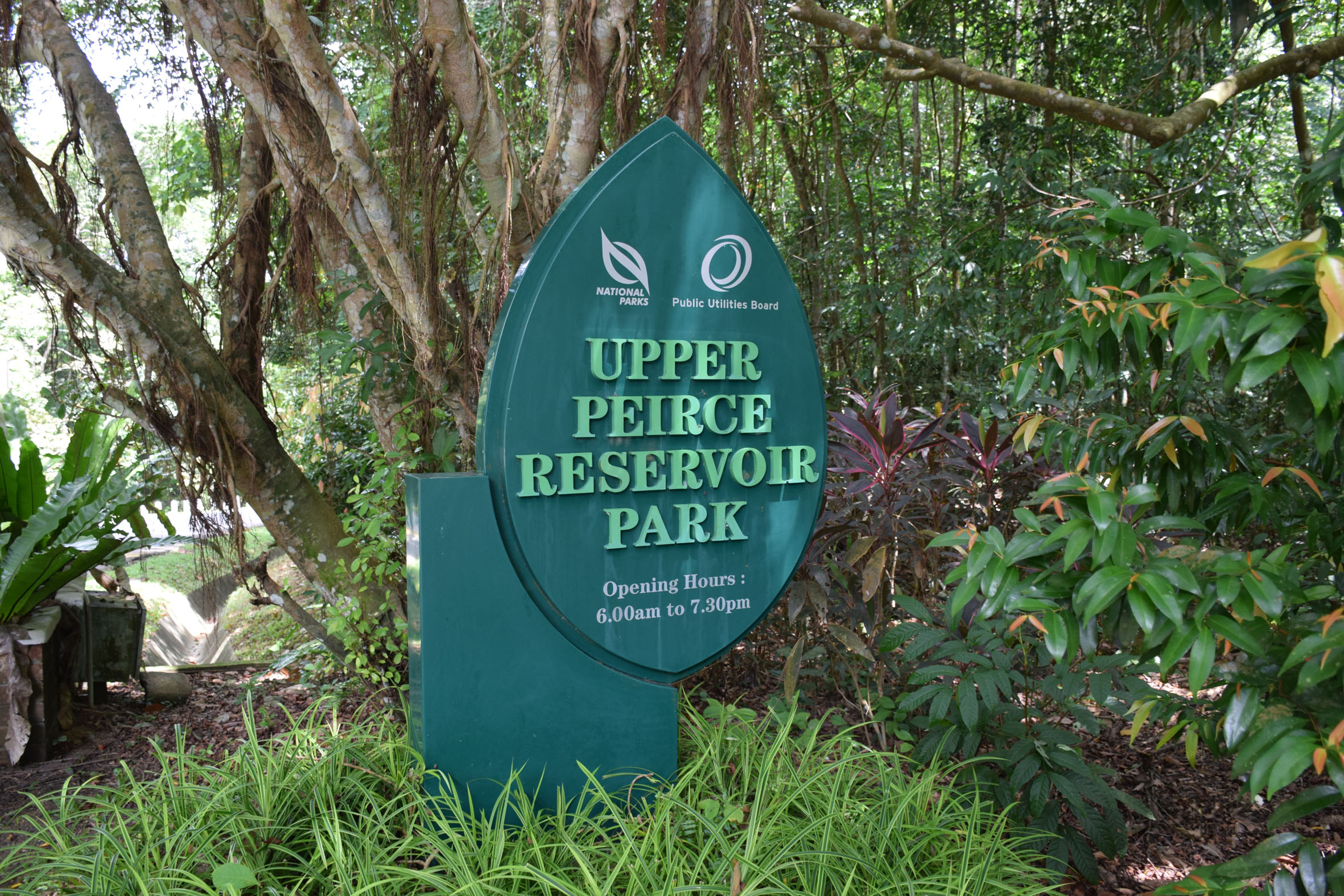
Unfortunately, the jumping spiders I’m working on (Orsima ichneumon) are not widely known from Singapore. They have been recorded here though, and so Caleb and I set off to Upper Peirce Reservoir in the central catchment on advice from Joseph Koh (local spider expert) who found one there some years ago.

upper pierceJoseph recommended following an unmarked trail where a series of pipelines cut through the forest. Orsima seem to like edge habitat like this and in Malaysia we had most luck finding them in areas where it was shady but got some sun. They particularly seemed to like hanging out on ginger fronds covered in vines.

Caleb on a pipe

The pipeline trail at Upper Peirce Reserve

Despite much beating and searching we didn’t have any luck on our quest for Orsima today, but we still had a lot of fun. For the first time on any outing in Singapore we didn’t see another human soul on the trail. Also, despite it recently feeling a little quiet in the forest we spotted and heard lots of wildlife including a baby clouded monitor, greater racket tailed drongo, bee eaters, tailor birds and macaques. One of the mama macaques was even nursing a tiny baby and posed long enough for a photo.

Mummy2

Long tailed macaque mama with baby

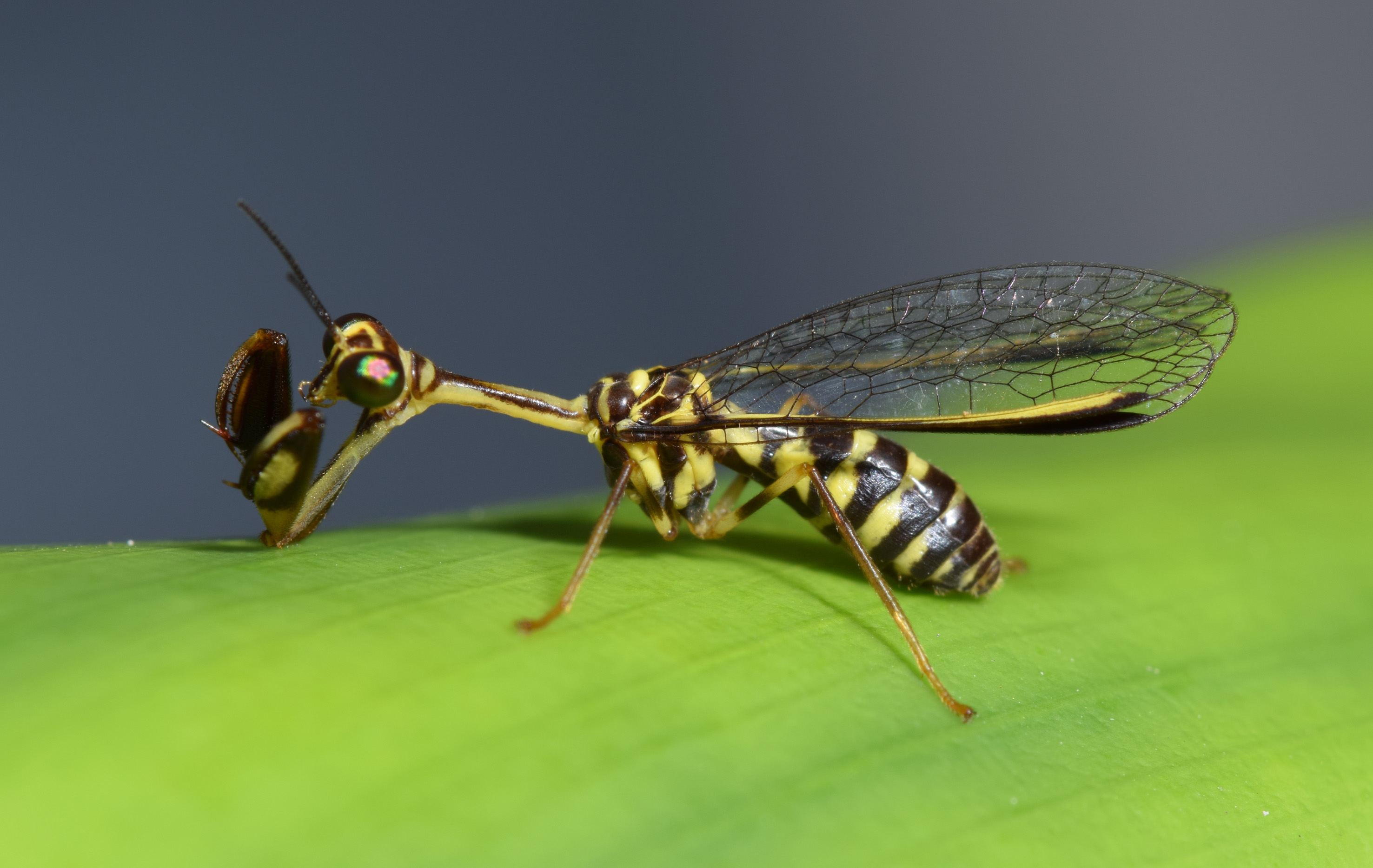
Of course, loads of beautiful spiders fell into our umbrellas as we were beating, but the find of the day was something I had never seen before – a mantidfly! This is one of the strangest insects I have ever seen, being a confusing blend of mantid and wasp. Techincally, mantidflies are not flies either – they are lacewings (Neuroptera). This particular species is a pretty convincing wasp-mimic, with its yellow and black patterning. Like a mantid, it has modified (raptorial) forelegs for capturing prey which Caleb tested out by feeding it a fly. This exciting find reminded me how incredibly diverse the invertebrate world is and how much more I am yet to see – it is so great to get a surprise everytime we go out.

mantidfly

Wasp-mimicking mantidfly, wow!

mantidfly2Here are just two of the many jumping spiders that we spotted today. We saw a lot of the very cute bumblebee jumpers as well as a couple of different Telamonia species including this bright yellow and orange one.

jumpers

Bumblebee jumper (Omoedus ephippigera), Telamonia sp.

While it wasn’t an entirely successful trip I’m hopeful that we will eventually find the elusive Orsima in Singapore, and our finds today made it feel like it was worth the day away from the lab.

Searching for Orsima jumping spiders but finding other treasures instead

Searching for Orsima jumping spiders but finding other treasures instead

Congratulations Bex!

IMG_4732

The world isn’t done hearing about giraffe weevils just yet!

Rebecca Le Grice finished her Masters at the University of Auckland in February under supervision of Greg Holwell and myself looking at competitive assessment, lifetime mating success, mark-recapture and other fun things on giraffe weevils. Bex has just been awarded an A+ and 1st Class Honours for her work – this is very much deserved for all her hard work, both in the field and back in the office doing some pretty complicated analyses.

Congrats Bex, looking forward to some great publications from your work.

Bex1

Here’s Bex enjoying a nice cup of tea at her field site (Photo: R Le Grice)

City living and jungle escapes in South East Asia

Singapore is a puzzling place to live. I am truly enjoying the diversity in culture, food and having the opportunity to do science in a new part of the world. But sometimes I feel like we are living in a bubble. Perhaps it is partly because it has been difficult to make friends here and so we spend a lot more time doing things as a couple than we might have at home. It could also be something to do with the constant temperature and humidity that never really waivers and makes me feel like I should be on holiday instead of going in to the office each day. Maybe too it is just that we haven’t been here long enough to feel like we belong and are still busy discovering new places to eat and explore without building much of a routine.

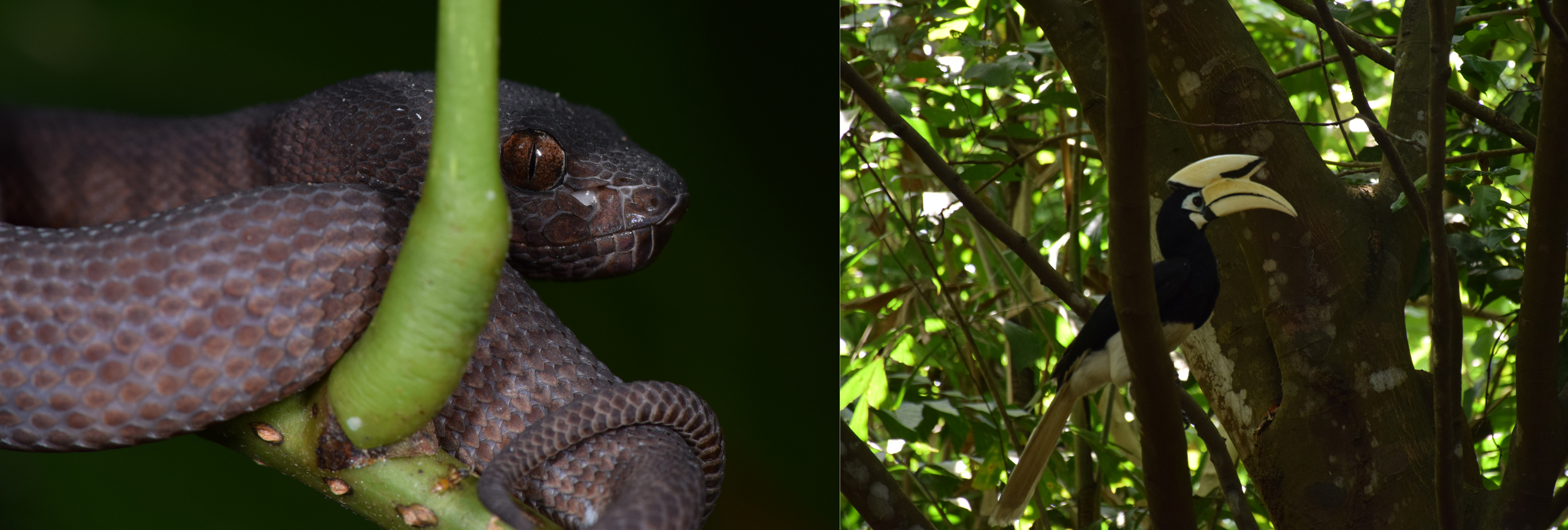
Whatever the cause, come the weekend I am desperate to get away from all the towering apartment blocks and find a quiet place to walk. This is pretty hard in Singapore and I am embarrassed to say that the kiwi in me gets a little annoyed when having to share a track with large numbers of other people. But then I think how nice it is that so many others are enjoying their weekend in the bush and I try to focus on the bird calls rather than the people. For a tiny and highly developed island, Singapore has a surprising number of wildlife to spot when exploring the remaining rainforest and urban parks. For my birthday recently, we took a trip to Sungei Buloh Wetland where Caleb outdid himself by spotting 3 different species of snakes, including a baby mangrove pit viper. (click on any of the photos to enlarge)

viper hornbill

A juvenile mangrove pit viper (Cryptelytrops purpureomaculatus) and an oriental pied hornbill (Anthracoceros albirostris) at Sungei Buloh Wetland

A huge bonus about working as a behavioural ecologist in Singapore is getting to do your field research in neighbouring tropical places. Our lab group recently took a road trip around Peninsula Malaysia in search of our various spidery study species, and Caleb got to come along as our trusty field assistant. We spent most of our time around the University of Malaya Gombak Field Station which is located in the foothills inland from Kuala Lumpur. Having breakfast on the deck over-looking the jungle is up there with my all-time favourite activities, especially when naughty long-tailed macaques spy at you from the trees.

I’ve recently started a new project on a magnificent jumping spider, Orsima ichneumon. This species belongs to the same subfamily that our lab does most of its research on, and I couldn’t help but jump on it myself when I found out that very little is known about its biology. Look at those colours and the strange ant or wasp-like morphology!

orsima

The wonderful Orsima ichneumon

Unlike in temperate areas, finding enough study specimens in the tropics can be a bit tricky, where diversity is incredibly high but abundance of each species typically lower. However, we eventually found a great spot of weedy undergrowth and shouts a plenty of “got one!” rang out in chorus with the pleasant sound of bush whacking. Here, my boss also introduced me to the use of an umbrella as a beat sheet (advocated by Joseph Koh in his book on Bornean spiders) – a rather genius invention for use in the wet tropics and can be very handy during sudden downpours!

group gunung nuang

Happy spider collectors on a jungle path

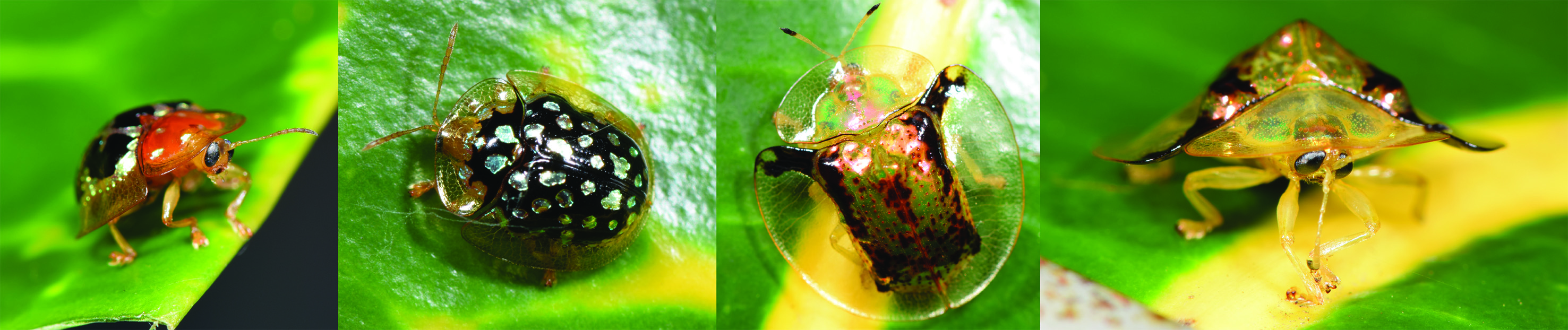
Until recently I wasn’t a big fan of beating as a collection method as I’ve always enjoyed the challenge of spotting things by eye. I’m converted now though and like a colleague recently said to me, it’s like discovering treasure when you peer into the umbrella. Not only did we discover many jumping spiders, but also lots of adorable beetles.

Beetles

Beetles from the beat sheet

In the evenings Caleb cracked out his macro photography set up and we catalogued the day’s findings.

Jumpers

A selection of salticids

I should also mention that we spent a lot of time eating splendid Malaysian food. It’s hard to choose favourites but I have a new fondness for stinky petai beans and anything with copious amounts of sambal (chilli sauce). Also for anyone following Caleb’s adventures with satay, don’t worry – he got his fill of that sweet peanut sauce on chicken on our last night in Kuala Rompin.

dinner

Left to right: Petai beans being prepared at a seafood restaurant in Kuala Rompin, Lunch in the Cameron Highlands, Corn on the satay coals

Overall it was a very successful trip. I can finally get some experiments underway back in the lab now and have returned feeling really refreshed after the break from city life. There may have been a lot of mosquitoes, leeches, spew-breaks and scratches (and even a mystery insect spray burn on my eyelid) but there is nothing like a good week in the bush to make you feel like we live on a pretty special planet.

chrissie in the jungle

Taking time out to watch birds at the Gombak Field Station

Horseshoe crabbing in Singapore

Last Saturday Caleb and I took part in a nationwide census of horseshoe crabs around Singapore. Since moving to a new country with such diverse wildlife we wanted to get involved in events which help us learn about local wildlife and conservation issues. This is the third survey organized by the Nature Society of Singapore since 2010 and aims to monitor horseshoe crab populations at 9 sites across the island. The society are particularly interested in how factors such as habitat loss, algal blooms and the fishing industry could be having on declining populations.

What is a horseshoe crab?

Despite their name, horseshoe crabs are not crabs and they aren’t even a type of crustacean. Instead they belong to the subphylum Chelicerata which also includes the more commonly encountered arachnids (spiders, mites, scorpions). Horseshoe crabs themselves belong to a special group of very ancient marine arthropods from the order Xiphosura, of which they are now the only living members of an ancient and otherwise extinct group.

Horseshoe crabs around Singapore

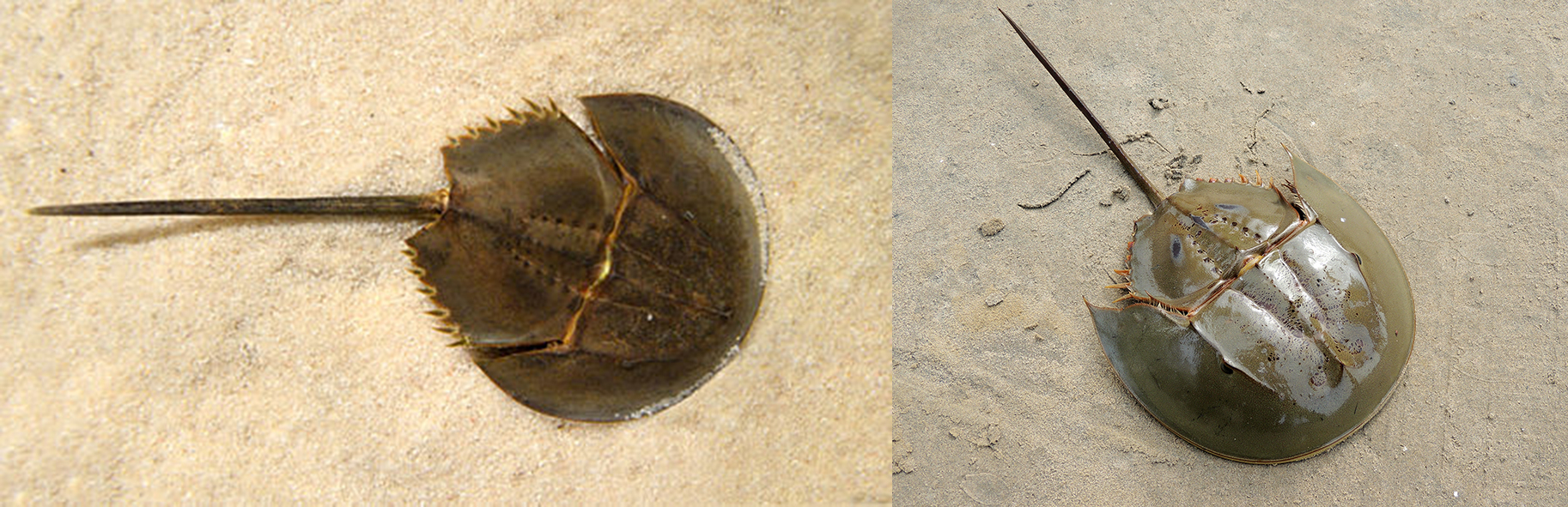
Two species of horseshoe crabs can be found in the waters around Singapore – these are the mangrove horseshoe crab (Carcinoscorpius rotundicauda) and the larger coastal horseshoe crab (Tachypleus gigas). They can be distinguished easily by looking at their “tails” (also known as telsons or caudal spikes), which are used to help them cruise around underwater and to help them right themselves if flipped over. The tails of coastal horseshoe crabs are triangular in cross-section and serrated and can be compared to mangrove horseshoe crabs which are round and smooth. Wild Singapore has some great info and pictures on how to tell them apart here.

horseshoe crabs

Mangrove horseshoe crab (Carcinoscorpius rotundicauda) & Coastal horseshoe crab (Tachypleus gigas) (Photos: Wikimedia Commons by Amada44 & Shubham Chatterjee, respectively)

Little is known about the biology of the two species found in Singapore but it is thought that unlike the American species which is famous for its annual mass spawning on sandy beaches along the Atlantic coast, the local species here probably breed year round.

The survey at Seletar Reservoir

Our work at Seletar Reservoir involved getting into teams and moving up and down the mud flat to survey for horseshoe crabs. It didn’t take long before we found out that the mud is extremely deep here (several stuck gumboots) and so it was actually pretty difficult to effectively survey the site. A huge thunderstorm also abated plans a bit, but after hiding out in a fisherman’s hut we ventured out to check out some of the fishing cages along the jetty.

IMG_0007

Some of the volunteer students checking out the stranded horseshoe crabs in fishing cages

Here we found 18 horseshoe crabs that had been trapped inside two fishing cages. Luckily they were all still alive when we pulled them out so we took some quick measurements and sexed the animals before releasing them back onto the mud.

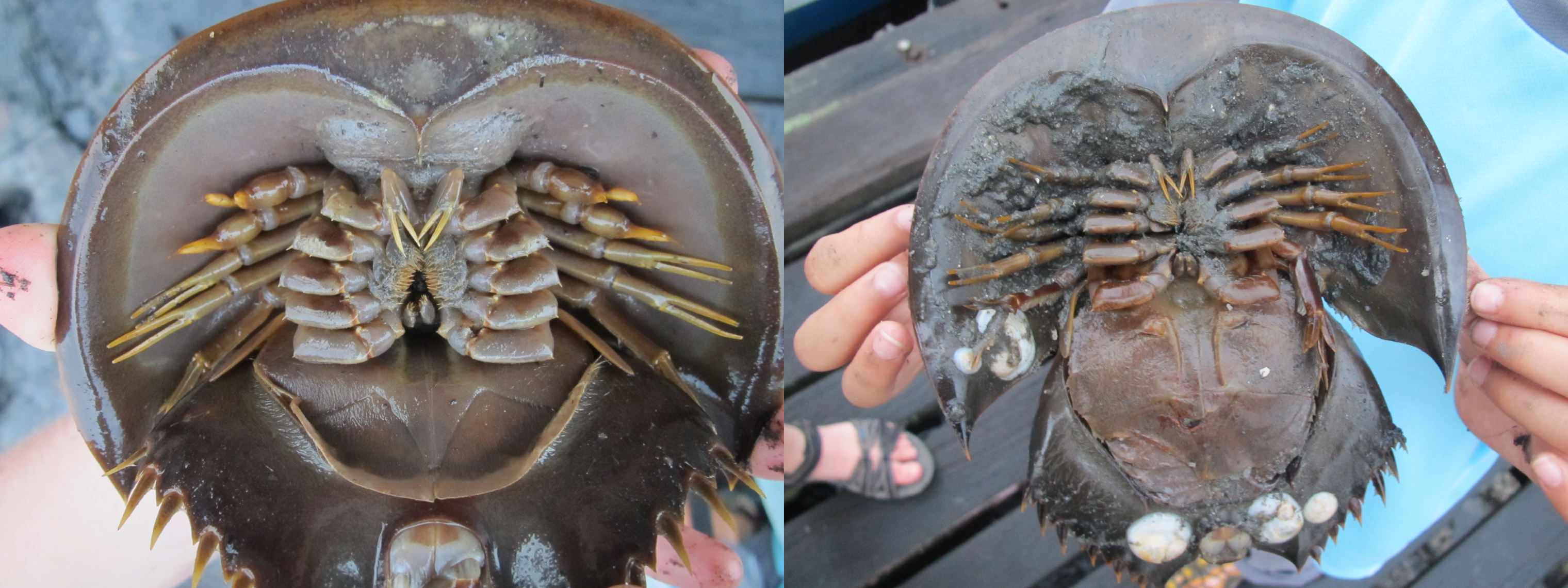
IMG_0020We had to distinguish between male and females by flipping the crabs over to check out their undersides. Males can easily be identified by looking at their front legs (pedipalps) which are swollen at the ends to resemble little boxing gloves. These are used to latch on to females for mating. The pedipalps of females look the same as their walking legs. Males are also generally smaller than females for all species of horseshoe crab.

horseshoe crabs_male female

Ventral view of mangrove horseshoe crabs: male on left with swollen “boxing gloves” near tip of pedipalps compared to females on right that have normal legs

A few brave souls also jumped into the deep mud beyond the jetty and found two large female mangrove horseshoe crabs with males attached. Both of these females had multiple satellite males hanging around, probably trying to fertilize eggs that the females were depositing in the mud (see Interesting Mating Behaviour below).

Threats to horseshoe crabs around Singapore

Populations of horseshoe crabs around Singapore are unfortunately declining, probably in large part due to loss of habitat around coastlines. Land reclamation has resulted in a loss of sandy beach habitat for the coastal species of horseshoe crab, so much so that this species is rarely sighted in Singapore now. Mangrove forests too have declined from 13% of Singapore’s land area to just 0.5%, leaving very few breeding sites left for the mangrove horseshoe crab.

The Nature Society also spends a lot of time pulling horseshoe crabs from fishing nets where they are accidentally stranded and risk death due to exposure at low tides.

Blue blood and the biomedical industry

Horseshoe blood is an incredible blue colour, due to the oxygen-carrying part which is called hemocyanin and contains copper. Vertebrates, on the other hand, have hemoglobin which contains iron, giving oxygenated blood its more familiar red colour.

horseshoe crab blood

Horseshoe crab blood (Image from PBS Nature documentary “Crash: A tale of two species”)

Horseshoe crab blood has become an extremely valuable tool in the biomedical industry. In the 1960’s it was discovered that horseshoe crab blood will clot when it comes into contact with bacterial endotoxins, effectively closing off the bacteria and preventing any further infection. Similarly for humans, bacterial endotoxins can be very dangerous, especially if they enter our blood stream which can happen during medical injections. Since the 1970’s, horseshoe crabs have been collected, harvested for their blood and used in LAL tests (Limulus amebocyte lysate). Any potential contamination in drugs for intravenous use will be detected during these tests because of the way the blood coagulates and forms a gel around the contaminant. From what I can see online, EVERY drug is tested using horseshoe crab blood which is truly amazing.  I had no idea before writing this blog that human medicine relies so greatly on these ancient creatures of the sea!

Check out this short clip from PBS Nature to learn more about how horseshoe crabs are used in the biomedical industry.

Interesting mating behaviour

I first learned about horseshoe crabs when reading work by Prof. Jane Brockmann from the University of Florida. Since 1989 Jane has been working on the American species of horseshoe crab (Limulus Polyphemus), which is found along the Atlantic Coast and in the Gulf of Mexico. Given my research background studying sneaky versus fighting male giraffe weevils, I found the mating behaviour of horseshoe crabs fascinating.

Jane and her team identified that males use two different mating tactics – younger males in the best condition attach themselves onto females and ride on to the beach with their partners, giving them the best chance for fertilization. Older males or those in poor condition adopt an alternative behaviour coined “satellite behaviour” which involves crowding around male/female pairs on the beach during spawning in an attempt to father a proportion of the eggs fertilized. This tactic is possible because females lay thousands of eggs into the sand which are not fertilized until males release free-swimming sperm – resulting in a huge amount of sperm competition between males.

Surprisingly, Jane found that satellite males are able to gain a large proportion of the paternity of offspring (on average 40%), demonstrating that it is worth the risk of possible death to engage in this battle for fertilization (unattached males are more likely to be flipped over in the waves, stranded by outgoing tides and eaten by migratory birds!).

Recent work by this team have reveled the interesting and complex trade-offs involved with being an attached versus satellite male. For example, although attached males have a greater overall mating success, they also suffer costs involved with their mating tactic such as being unable to feed as easily resulting in nutritional stress.

IMG_0015

Thanks to the Nature Society of Singapore for letting Caleb and I tag along and learn a lot of interesting things about a species we had never encountered before. If you are in Singapore and want to volunteer to help the society with their rescue missions you can find information here.

Further reading

Nature Society Horseshoe Crab Research & Rescue Programme: details about the project can be found here as well as links to some great articles written about the plight of horseshoe crabs around Singapore

Fact sheet from Wild Singapore: general information as well as helpful guide to distinguishing between the two species found in Singapore

Lots of information about horseshoe crabs by the Ecological Research & Development Group including anatomy, natural history, research etc. Most research has been done on the American species but you can spend ages on this site learning lots of neat things about horseshoe crabs.

IMG_0036

Sunset over Seletar Reservoir at low tide

Drawings by Emma Scheltema

Last year the Holwell lab was lucky to meet Emma Scheltema, who was kind enough to do a bunch of illustrations for us of our various study species. I’m looking forward to including her work in our upcoming publications.

You can see some of her beautiful work here but for her full portfolio you should check out her website.

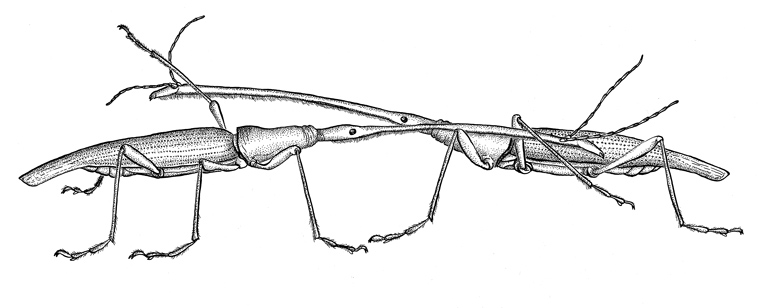
malesfighting_shaded_gscale_webverTwo male giraffe weevils grappling  – one of Emma’s creations

A new life in Singapore

I recently made one of those decisions which, although pretty normal for a lot of academics, meant uplifting my life in New Zealand and moving to Singapore. I finished my PhD almost 2 years ago now and have been lucky to get several postdoc positions, one at the University of Auckland (where I did my PhD) and a shorter stint at the Australian National University (playing with fiddler crabs in Darwin).

photos for blog(left to right) 1. Male Forsteropsalis harvestmen eating a fly, 2. Male Pantopsalis cheliferoides harvestmen, 3. male Uca elegans fiddler crabs jostling for a burrow

These opportunities allowed me to get publications from my thesis out, make some new collaborations and delve into new research areas. The time had come, however, to head off and do something different and so I jumped at the chance to take up a research fellowship at the National University of Singapore. Although exciting, this has meant that my husband and I had to make the decision whether to do this together or live apart for the next couple of years. We decided (after much discussion & ultimately sacrifice on his part) that he would come along too & so he quit his job, we packed up our house, put all our belongings in storage and off we went to Singapore!

DSC_0123

Strolling around Kent Ridge Park

So here we are, a few weeks into our new life living in a country the same size as my old city but with a LOT more people. The upside is that living in the tropics means there is a pretty incredible amount of wildlife to see, even in a little city park or on campus on my walk to work in the mornings. I’ve been having fun ticking off the birds on campus using this handy website & this great app of Singapore birds. I even found out today there is an app for the snakes of Singapore which is great as we have already spotted three snakes while out and about. I’ve also realized that birding is a great way to make friends – on the weekend we met a Singaporean bloke called Philip who gave us all the latest gossip on where to see an orange headed thrush (you take the track at Bukit Timah with the stairs, turn left, then go straight and you should see a bunch of other birders with their tripods). He also told us how to find this super cute baby Spotted Wood Owl at Pasir Ris Park which we spotted snoozing up high in a tree near the beach (turns out we need a better zoom lens).

OwlAnyway, before anyone mistakes me for biologist working on charismatic megafauna, I should mention that I’m actually here to work on jumping spiders (Salticidae). As anyone who has a love for jumping spiders will know, they are renowned for their incredible diversity in colour and their charming courtship behaviours.

jumping spidersI’m going to be exploring a few different questions, but the main aim is to trace the origin and evolution of UV-colour in male jumping spiders and to compare this to how females use male colour to make judgments on male mate quality. Daiqin Li’s group ­­has already done a fair amount of work in this area already, which is actually really exciting for me as I spent a lot of time during my PhD working out the very basics of giraffe weevil ecology. Here I can jump in and build on all the great stuff already done and hopefully get stuck in to some bigger picture research such as using phylogenies to map the evolution of colour & its use in mate choice.

In the meantime, here are a couple of pics we’ve taken when out exploring the local parks on the weekends – still need to get a macro lens so mostly larger animals so far!

photos for blog(left to right) Female laced woodpecker, Clouded monitor lizard, Painted bronzeback snake